-
What is the process from sample testing to bulk order?
Answer: First, after sample order payment is confirmed, we will arrange to ship sample within 1~2 working days, you will receive it in about 5~10 days, then engineer will assist your team to test the sample. We recommend bulk order after the local sample was tested and approved.
-
How long is the delivery time for small orders?
Answer: Sample order (less than 10 pieces) within 1~2 working days; trial order within 15 working days. More days are required if custom software, apps, brand logo and packaging customization are required.
-
What is the process for software customization solutions?
Answer: Share all logos and UI images with us, Google Play and Apple Store developer accounts are required, after complete web tracking platform, Android and iOS APP development, we will release to Apple Store and Google Play for you, it normally takes about 20~30 working days.
-
Do I need to be a reseller first if I want to customize my own brand?
Answer: No, becoming a distributor is more about selling our existing brands and white-label products, without progression and priority. You can find us if you have customized needs.
-
What is the cost and time period for customizing your own brand?
Answer: Each scheme and cost are different, mainly based on actual needs, including different hardware functions and software functions, and different costs. Specific analysis of specific projects is required to give a reasonable quotation and delivery cycle.
-
Does the cycle of customizing one's own brand need to be customized with software?
Answer: No need, we can provide one-stop customization services for software and hardware, and it is also possible to customize only hardware products, software platforms and APPs according to your company's specific business needs.
-
How to find a gps tracker on your car? A Comprehensive Guide (Updated 2025)
The details please check on article: https://www.huatenglobal.com/news/industry/20.html
-
Q1: Do I only need to provide a logo file for branding customization? What else is required?
A: In addition to your logo (please provide editable formats such as Photoshop or Illustrator), you need to confirm customization details (e.g., printing position, color, packaging design) and provide Pantone color codes if you have specific color requirements.
-
Q2: Why is branding customization free? Is the 1000-unit MOQ strictly required?
A: Branding customization (logo printing, color changes, packaging) does not involve mold modifications or R&D investment, as it utilizes existing production lines, so it's offered free of charge. The 1000-unit MOQ is the minimum required to maintain cost efficiency. Smaller batches may be negotiable but will have higher unit prices.
-
Q3: Can we see samples before deciding? Is there a sample fee?
A: Yes, we provide digital proofs or physical samples for confirmation. Sample fees are typically charged at cost and can be refunded or deducted from the bulk order amount later.
-
Q4: Will the customized products only display our brand? Can the original brand be retained?
A: Complete white-labeling is provided—all brand elements will be yours, with no trace of the original manufacturer's brand.
-
Q5: What is the core difference between semi-customization and branding customization?
A: Semi-customization involves hardware function or structural modifications (e.g., adding/removing sensors, changing button positions, adjusting battery capacity), which requires engineering input and therefore incurs mold or development fees. Branding customization only covers appearance and packaging.
-
Q6: How much do semi-customization mold fees typically cost? How soon can they be refunded?
A: Mold fees range from a few thousand to tens of thousands of dollars, depending on complexity. Upon reaching an agreed cumulative order quantity (e.g., 10,000–20,000 units), part or all of the mold fee may be refunded.
-
Q7: Can we modify only the firmware without changing hardware? Does this count as semi-customization?
A: Yes, firmware configuration (e.g., reporting strategies, alarm thresholds) falls under semi-customization. If no hardware changes are involved, it's typically free or requires only a small development fee.
-
Q8: Why is the MOQ for semi-customization higher than for branding customization?
A: Because engineering validation and mold cost amortization require larger order volumes. 3,000 units is a common threshold, but this can be negotiated.
-
Q9: How long does it take from concept to mass production for a new design?
A: The typical cycle is 6–9 months, covering concept definition, industrial design, structural design, electronic design, mold development, and testing/certification. Higher complexity or special certifications (e.g., medical, explosion-proof) may extend this timeline.
-
Q10: How are fees structured for new design projects?
A: Payment is typically split into three phases: 50% upon contract signing (R&D initiation), 35% after T1 sample confirmation, and 15% after T2 final confirmation. Mold and certification fees are quoted separately.
-
Q11: Can we participate in the development process? How do we ensure the final product meets expectations?
A: Yes, we involve you at every key milestone: T0 appearance confirmation, T1 functional testing, and T2 final validation. Samples are provided for testing and review at each stage to ensure alignment with your expectations.
-
Q12: Who owns the intellectual property for a new design product?
A: As contractually agreed, generic technology platforms may be jointly owned or retained by us, but client own the exclusive right and we will not sell to others clients without permission, subject to negotiation.
-
Q13: Can you provide CE/FCC certification services? Are certification fees included in development costs?
A: We can assist with certification testing. Certification fees are typically not included in development costs and are quoted separately based on target markets.
-
Q14: Will mold fees be refunded upon reaching the agreed order quantity?
A: Yes, partial or full refund of mold fees is common upon reaching agree quantity, as specified in the contract.
-
Q15: After basic branding customization, is the platform functionality different from your original system?
A: Functionality is identical—only the brand elements are replaced with yours. You receive the full TRACK IN360 feature set, including real-time tracking, geofencing, reporting, and API access.
-
Q16: How long does it take to get the customized app listed on Google Play and the App Store?
A: Approximately one week after testing and acceptance. You need to provide developer accounts or authorize us to publish on your behalf.
-
Q17: Where are servers located for basic branding customization? Is data storage secure?
A: By default, we use AWS cloud servers in Hong Kong or Singapore, compliant with international privacy standards like GDPR. For data localization, please refer to Option #5.
-
Q18: Do we need to provide a Google Maps API key?
A: Yes, you need to provide a Google developer account and apply for a Maps API key, or we can assist with the process (additional fees may apply).
-
Q19: Does basic customization support multiple languages? Who provides translations?
A: The platform supports 10+ languages by default. For additional languages, you provide translation packs (Excel format), and we handle integration and adaptation.
-
Q20: After localized deployment, do we have full control over our data? Can you still access it?
A: Yes, the system is deployed on your designated servers, giving you complete data control. We cannot access your data but can provide remote maintenance support (requires VPN or jump server access).
-
Q21: What server specifications are required for localized deployment?
A: As detailed in the document:
Application Server: 8-core CPU, 16GB RAM, 200GB SSD, Windows Server 2019+, 5Mbps public network.
Database Server: 8-core CPU, 16GB RAM, 300GB SSD, SQL Server 2019+, private network only
-
Q22: Do you handle installation and deployment? Do we need to provide system administrators?
A: Yes, We will deploy for you remotely, you need to have system administrators available for coordination.
-
Q23: How are software updates and maintenance handled after localized deployment?
A: The first year of maintenance is free, covering bug fixes and security updates. Annual maintenance contracts can be signed from the second year onward. Major version upgrades are quoted as projects.
-
Q24: Can you integrate with our existing systems (ERP, TMS)?
A: Yes, we provide API access and can develop custom integration modules. Costs depend on complexity.
-
Q25: How long does it take to develop a completely new system?
A: Depending on complexity, 6–12 months, covering requirements analysis, product design, UI design, frontend/backend development, testing, and deployment.
-
Q26: Who owns the source code for a new system development?
A: Client-funded specific code belongs to the client. We deliver complete source code, database scripts, and deployment documentation. Core platform frameworks may be retained by us, as defined in the contract.
-
Q27: What if requirements change during development?
A: We document changes, assess impact on timeline and cost, and proceed upon mutual agreement. Significant changes may require a contract amendment.
-
Q28: How do you ensure system stability after development?
A: We conduct functional, stress, and security testing, and provide an operations manual. A free maintenance period (typically 3–6 months) is included post-delivery.
-
Q29: Have you developed systems for similar industries? Can you share case studies?
A: Yes, we have extensive experience in logistics, personnel safety, asset tracking, and more. Case studies can be shared under NDA.
-
Q30: Must hardware and software customization be done together? Can they be separated?
A: Absolutely. You can customize hardware only and use our platform, customize software only and use our hardware, or customize both. We offer flexible collaboration options.
-
Q31: Can we start with a small trial order before committing to deep customization?
A: Certainly. We recommend starting with standard or branded products for market validation, then moving to semi-customization or new development based on confirmed demand—this reduces risk.
-
Q32: What happens if a custom project is delayed or fails? How is this addressed in contracts?
A: Contracts specify delivery milestones, acceptance criteria, and liability for delays. We provide regular progress updates and samples for confirmation at key stages. Compensation clauses apply for delays caused by us.
-
Q33: Can you sign a non-disclosure agreement?
A: Yes, we sign mutual NDAs before any technical or business discussions to protect your IP and business plans
-
1.What is the difference between GNSS and GPS?
GPS is a type of GNSS. GNSS is a general term for all global satellite positioning systems.
GNSS (Global Navigation Satellite System) is a collective term for all satellite navigation systems that provide global coverage. It includes the four major global satellite navigation systems: GPS, BeiDou, GLONASS, and Galileo, as well as several regional systems such as QZSS (Japan) and IRNSS (India).
-
2.What is GPS drifting and how to avoid it?
GPS drift is the result of a combination of physical laws, environmental factors, and technological limitations, and cannot be completely avoided. Just as any measurement system has errors, positioning systems cannot achieve absolute precision.However, as a professional IoT GPS locator solution provider, our goal is not to "eliminate drift," but rather to control its impact to an acceptable level in specific application scenarios through hardware-level optimization, firmware-level algorithms, software-level post-processing, and multi-source positioning fusion. For detailed explanations, please see the article: What is GPS drifting and how to avoid it?
-
3.What are GNSS cold start, warm start, and warm start?
Why do some GPS devices take a relatively long time to get online for the first time, while others can get a fix quickly? This involves the cold start, warm start, and warm start of the GPS module. For a simple explanation, please refer to the article: What are GNSS cold, hot and warm start in a GPS tracker?
-
4.Does all GPS tracker need a SIM card?
No, not all require it. But if you need real-time remote monitoring—a core requirement for the vast majority of enterprise applications—then yes, you'll need a tracker with a SIM card. Different types of positioning devices cater to different scenarios:
Real-time Cellular Tracker: Requires a SIM card; suitable for vehicle, asset, and personnel monitoring.
GPS Recorder: SIM card not required; suitable for post-event trajectory analysis.
Bluetooth Tracker: SIM card not required; suitable for locating nearby objects.
Satellite Tracker: Connects to satellite networks; suitable for areas without cellular coverage.
The key to choosing the right solution is to clearly define your business scenario: Is real-time monitoring required? Is remote monitoring required? Are alerts required?
Huaten Global primarily offers a full range of 4G trackers with SIM cards that enable real-time remote monitoring. Regardless of your deployment scenario, we can provide a suitable solution. For more detailed information, please see the article: Does all GPS tracker need a SIM card?
-
5.Can GPS tracker work without internet?
GPS reception itself is completely free, passive, and one-way. The tracker only needs to "hear" the satellite signals to calculate its own location. This process does not require sending any information to the satellites or involving the cellular network. That is, the device can obtain location information normally, but it cannot transmit it to the tracking backend in real time.
Our trackers still working under no internet environment:
Continue receiving GPS signals and calculating location.
Securely store all data in a local cache.
Automatically retransmit historical tracks when the network is restored.
Ensure critical alarm events are prioritized for retention.
For more detailed information, please refer to the article: Can GPS tracker work without internet?
-
6.Do all GPS trackers require a monthly fee?
GPS signals are public and free in themselves.
However, the locator transmits its location to you via the 4G network, and your mobile carrier charges for the data usage on your SIM card.
We provide a management platform and app that are free to use for life. For details, please see the article:
We provide a management platform and app for lifetime free use, free of charge. See the article for details: Tracking GPS Systems Web Platform and Apps Introduction
-
7.Are GPS trackers truly providing "real-time location tracking"?
If you need to equip your family, pets, assets, or vehicle with trackers, our solutions will let you truly experience the value of "real-time" (typical latency of 2-5 seconds)—not zero latency in the lab, but reliable, fast, and usable in the real world. What is the fundamental difference between real-time location and zero latency? Please see the article: Is GPS positioning truly real-time?
-
8.How does a GPS tracker connect to a phone?
The most common way for GPS trackers to connect to a mobile phone is through a cloud relay: the tracker uploads its location to a cloud platform via a 4G network, and your mobile app then downloads and displays the data from the cloud platform. This method enables remote monitoring capabilities from anywhere in the world, anytime, and is a standard solution for enterprise applications. For short-range location searching or on-site debugging, Bluetooth direct connection is an efficient supplementary method. For detailed explanations, please see the article: How does a GPS tracker connect to a phone?
-
9.Why is my GPS tracker location not always accurate?
First and foremost, in GPS positioning mode, GPS is a systems engineering project influenced by physical environment, technological limitations, and cost constraints, rather than a mythical "God's-eye view." Satellite signals can be blocked, reflected, and attenuated; receivers require time locking, calculation, and filtering; hardware and antennas have physical limits; and the environment is constantly changing.
Secondly, in addition to achieving a balance between engineering optimization and cost control, Huaten Global employs fusion positioning technology across its entire product line. In Wi-Fi or LBS positioning modes, the accuracy can be significantly higher, ranging from 10 to 1000 meters.
But more importantly, in most commercial scenarios, this "imperfection" is acceptable and can be managed through systems engineering approaches.
Huaten Global's value does not lie in manufacturing "absolutely accurate" GPS—which is physically impossible. Our value is:
Deeply understand the balance between the technical limitations of GPS and business needs.
Through continuous optimization at the hardware, algorithm, and system levels, we control inaccuracies within acceptable business limits.
We provide customers with transparent accuracy specifications and configuration tools, ensuring that positioning data truly serves business decisions.
Location tracking should be knowable, controllable, and reliable. This is precisely the direction we strive for every day. For a detailed explanation, please see the article: Tracker Positioning Accuracy Analysis of Error Sources and System Limitations (And How to Improve It)
-
10.What is the battery duration for tracking devices?
This is one of the most pressing questions for both enterprise customers and individual users when choosing a GPS tracker. The answer is simple: there's no single answer; the timeframe can range from a few days to several years, depending entirely on the device type, usage scenario, and configuration. See the article for more information. Seven Key Factors Affecting Your GPS Tracker Battery Duration.
-
Q1: Under what conditions was your claimed "2–5 meter accuracy" measured? Can we achieve this level of accuracy in a real-world environment?
A: The 2–5 meter figure represents the typical accuracy (CEP 50%) under conditions of an open sky, with the device remaining stationary or moving at low speeds. This means that in 50% of cases, the margin of error falls within this range; in the remaining 50% of cases, the error will be greater. In actual deployments, accuracy varies depending on the environment: 3–8 meters on suburban roads, 5–15 meters on urban streets, and 10–30 meters in areas with dense high-rise buildings. We recommend conducting prototype testing within your specific deployment environment to obtain realistic performance data.
-
Q2: Why does the positioning error suddenly increase in urban environments? What are the primary factors responsible?
A: Urban environments are primarily influenced by two factors: 1) Multipath effects (accounting for 60–80% of the error): Signals are reflected off high-rise buildings, making it impossible for the receiver to distinguish between direct and reflected signals, which results in a positional shift; 2) Degraded satellite geometry: High-rises obstruct the view, causing visible satellites to cluster within a narrow section of the sky, thereby worsening the Dilution of Precision (DOP). The combined effect of these two factors causes the positioning error to expand from the 2–5 meters typically observed in open terrain to 10–30 meters.
-
Q3: Is GPS positioning lost when a vehicle enters or exits a tunnel? How long does it take to recover the signal after exiting?
A: GPS signals are completely lost while inside a tunnel. Our devices utilize Inertial Navigation (IMU) assistance: upon entering a tunnel, the device estimates the vehicle's position based on its last valid location, speed, and heading; for short tunnels (under 500 meters), the recorded trajectory remains continuous and uninterrupted. After exiting a tunnel, aided by A-GPS (which downloads satellite ephemeris data via the cellular network), signal re-acquisition typically takes 3 to 10 seconds. All data generated inside the tunnel is cached locally and automatically uploaded once the vehicle exits, ensuring that no data is lost.
-
Q4: Does positioning accuracy decrease when traveling at high speeds (120 km/h)?
A: When traveling at high speeds, the Doppler effect causes a shift in signal frequency, which may result in a brief positioning lag. Our devices utilize high-dynamic reception algorithms; consequently, the decline in accuracy is negligible at speeds up to 150 km/h (with an error increase of approximately 20%). Based on actual test data: at a speed of 120 km/h, the 95% error margin increases by approximately 3–5 meters compared to a stationary state. While the trajectory may exhibit a slight "trailing" effect, this does not compromise the overall determination of the travel path.
-
Q5: Will there be variations in positioning accuracy between different devices of the same model?
A: Every product batch undergoes RF calibration and positioning consistency testing; under identical environmental conditions, the variation is typically less than 10%. We can provide factory test reports and support consistency verification using sample units prior to bulk purchasing. Any batch-to-batch variations are primarily caused by changes in component suppliers; we ensure consistency through rigorous IQC (Incoming Quality Control) and IPQC (In-Process Quality Control) procedures.
-
Q6: Will the device's accuracy degrade after one year of use?
A: The antenna and RF circuitry themselves will not experience significant degradation due to aging. However, a drop in battery voltage may affect the receiver's sensitivity (particularly in devices utilizing non-rechargeable batteries). We recommend regularly monitoring the battery status; the platform provides a low-battery alert (triggered when the remaining charge reaches 20%) to ensure that batteries are replaced or recharged in a timely manner—before any decline in accuracy occurs.
-
Q7: Does a firmware upgrade alter the positioning algorithm? What should I do if positioning accuracy degrades after an upgrade?
A: Firmware upgrades may include algorithm optimizations; however, we conduct rigorous testing prior to every release to ensure that positioning accuracy remains undiminished. We employ a phased rollout strategy, allowing you to first test the update on a small subset of devices and proceed with a mass upgrade only after confirming everything is functioning correctly. Should any issues arise, you can utilize our one-click rollback feature to revert to the previous version, thereby ensuring business continuity.
-
Q8: How can we verify your accuracy data before placing a bulk order?
A: We strongly recommend conducting a pilot test: purchase 2–5 sample units and operate them in your actual deployment environment for 1–2 weeks. We provide remote technical support to assist with setting up the test protocol, collecting data, and analyzing the results. The cost of the sample units can be credited against a subsequent bulk order. The resulting test report will serve as the basis for your evaluation and decision-making.
-
Q9: If we conduct local testing and find that the accuracy does not meet the required standards, how do you provide support?
A: We offer a three-tiered support system: 1) Remote Diagnosis: Analyzing the issue through platform logs (covering installation location, signal obstruction, and parameter configuration); 2) Parameter Optimization: Adjusting reporting frequency, filtering parameters, and auxiliary positioning strategies; 3) On-site Support: For major projects, we can dispatch engineers to the site to conduct troubleshooting. The vast majority of accuracy-related issues can be resolved through the first two steps.
-
Q10: How does the GPS accuracy of your devices compare to Apple's Find My network (AirTag)? Which is more accurate?
A: The two technologies operate on different principles and cannot be directly compared. In open outdoor environments, the positioning accuracy of a GPS tracker (2–5 meters) is superior to that of an AirTag (5–20 meters), and it provides real-time updates. Indoors, at close range (<10 meters) and when paired with UWB technology, an AirTag can achieve an accuracy of 0.3 meters; however, its location updates rely on passing devices and are not real-time. For scenarios requiring continuous, real-time monitoring—such as vehicle anti-theft or personal safety—a GPS tracker is the only viable choice.
-
Q1: Why is the first time GPS fix on my new device so slow?
A: This is a typical "cold start." The device needs to search for satellites and download almanac and ephemeris data from scratch, which typically takes 1–3 minutes. Once the initial fix is successful, subsequent startups will be much faster.
-
Q2: The device was parked in a lot overnight, why does it still acquire a GPS fix so quickly when started the next day?
A: If the parking duration does not exceed 4 hours, the ephemeris data remains valid, allowing the device to perform a "hot start." If the duration exceeds 4 hours but is less than a few days, the device may still retain almanac data, enabling a "warm start" (taking 15–30 seconds).
-
Q3: How can the First Fix time GPS positioning speed be accelerated in remote areas completely devoid of cellular signal?
A: In such scenarios, A-GPS cannot be utilized. Recommendations: 1) Endeavor to keep the device powered on continuously; 2) If the device must be powered off, ensure that the stored ephemeris data is up-to-date; 3) Consider using a device that supports multiple satellite constellations to increase the probability of acquiring available satellites.
-
Q4: Why does my GPS tracking device sometimes suddenly slow down?
A: Possible reasons: 1) The device has moved to a new region (cold start); 2) The device has restarted after a prolonged power outage; 3) Signal obstruction is preventing ephemeris data from updating; 4) Low battery voltage is affecting receiver performance.
-
Q5: Does a prolonged cold start affect battery life?
A: Yes, it does. The power consumption of a single cold start is equivalent to that of 30 to 50 hot starts. This is because, during a cold start, the receiver must operate at full power to search for satellites and download ephemeris data. If the device undergoes frequent cold starts—such as being powered off and restarted daily—its battery life will be significantly reduced. We recommend keeping the device continuously powered on or utilizing a low-power standby mode to avoid frequent complete power-offs.
-
Q6: How long does a hot start remain valid? How long after the device loses power is a hot start still possible?
A: Ephemeris data remains valid for approximately 2 to 4 hours. If the device has been powered off for less than 2 hours, it will typically perform a hot start (1–5 seconds) upon powering back on. If the power-off duration is between 2 and 4 hours, it may enter a warm start (15–30 seconds). If more than 4 hours have elapsed, the ephemeris data becomes completely invalid, and the device will enter a cold start. Our devices feature a built-in, battery-backed Real-Time Clock (RTC); consequently, even if the main battery is depleted, the time information is retained, which facilitates faster positioning.
-
Q7: How long does it take for your vehicle GPS device to re-establish its position after exiting a tunnel or underground garage?
A: Upon exiting a tunnel, the device utilizes A-GPS to rapidly acquire ephemeris data; the time required to re-establish a position is typically between 3 and 10 seconds. Concurrently, while inside the tunnel, the device activates inertial navigation (IMU) to perform dead reckoning, thereby ensuring a continuous trajectory. After exiting the tunnel, the discrepancy between the actual position and the estimated position is typically within 10 to 30 meters, and this deviation converges to standard GPS accuracy within a few seconds.
-
Q8: Does the cold start time increase as the device ages?
A: Device aging primarily affects battery performance and antenna sensitivity. If the antenna ages or becomes damaged, signal reception capabilities will decline, which may result in a longer cold start time. A drop in battery voltage can also impact receiver performance. We recommend regularly monitoring the device's status; our platform provides signal quality trends and low-battery alerts to help you detect potential issues in advance.
-
Q9: Is there a significant difference in cold start times between GPS chips from different brands?
A: The difference is indeed significant. Industrial-grade chips (such as those from u-blox or Quectel) typically achieve a cold start 20–30% faster than consumer-grade chips; this advantage is particularly pronounced in weak-signal environments. Some of our high-end models utilize industrial-grade multi-constellation chips, combined with A-GPS optimization, to ensure that cold start times remain within a reasonable range. These specific differences can be verified through comparative testing of sample units.
-
Q10: If the device remains unpowered for an extended period during transit (e.g., via sea or land transport), will its initial positioning be slow upon reaching the destination?
A: Yes. Restarting the device after a prolonged power outage constitutes a "cold start," which typically takes 1 to 3 minutes. For scenarios requiring immediate positioning upon arrival (such as tracking containers at port), we recommend the following: 1) Keep the device in a low-power standby mode—rather than completely powered off—during transit; 2) Utilize the motion-detection wake-up mode, allowing the device to automatically wake up when movement is detected; or 3) Remotely wake up the device via the platform prior to arrival to complete the positioning process in advance.
-
Q11: Can your devices report their location during a cold start?
A: Before the cold start is complete, the device has not yet acquired a GPS fix and therefore cannot report precise coordinates. However, our devices support Cell Tower Location (LBS); during the cold start phase, they can initially report a location based on cell tower data (with an accuracy of 100–3,000 meters), and then update to the precise location once a GPS lock is established. This approach ensures a rapid response to user requests without compromising final accuracy.
-
Q12: Will the vehicle's tracking data be lost if it is driven away during a cold start?
A: No. During a cold start, the device continuously searches for satellites and begins recording its position as soon as a lock is established. If the vehicle begins moving before a lock is acquired, the device will record the trajectory starting from the moment the lock is achieved; consequently, the data for the preceding period—ranging from a few tens of seconds to several minutes—will indeed be missing. However, our devices feature a "motion wake-up" function: by detecting vehicle movement to proactively activate the GPS module, this feature helps minimize data gaps caused by cold starts. For critical applications, we recommend keeping the device continuously powered to avoid cold start scenarios.
-
Q13: How can I verify the device's startup time before making a bulk purchase?
A: We recommend conducting prototype testing: purchase 2–5 sample units and test their cold start, warm start, and hot start times within your actual deployment environment. Testing Method: 1) Power on the device after it has been completely powered off for more than 4 hours, and record the time required to acquire the initial position fix (Cold Start); 2) Power on the device after it has been powered off for 2–4 hours (Warm Start); 3) Power on the device after a brief power interruption (Hot Start). We provide testing tools and remote support to assist you in completing this verification process.
-
Q14: If the device remains unused for an extended period (e.g., several months), what state will it be in when powered on again?
A: Powering on the device after a prolonged power interruption (>24 hours) results in a "cold start." In this state, both ephemeris and almanac data have expired, requiring the device to search for satellites from scratch. If the battery completely drains during storage, time information may also be lost; consequently, the cold start acquisition time could approach its upper limit (2–3 minutes). It is recommended to fully charge the device before placing it in long-term storage and to store it in a dry environment.
-
Q15: What technical support can you provide regarding startup time issues?
A: We offer: 1) Testing Tools: A dedicated app designed to record the time required for the initial position fix; 2) Log Analysis: The ability to view the startup type and duration for each positioning event via our platform; 3) Parameter Optimization: Adjustments to A-GPS configurations and motion-triggered wake-up strategies based on specific usage scenarios; 4) On-site Support: For major projects, we can dispatch engineers to assist with optimization and deployment. We provide comprehensive technical support throughout the prototype testing phase.
-
What does mean IoT products based on mobile cellular network and location technologies?
All our products are based on Cellular (GSM, CDMA, WCDMA, LTE) and Satellite technologies, achieve No Distance Limited remotely real-time monitoring and tracking. Includes GPS smart watch for kids and elderly personal tracking, Non removable tracking bracelet, wires and wireless GPS device for assets tracking, OBD2 GPS dongle for car tracking and diagnosis, pet tracking collar and animal solar locator, portable and mini tracker for multiple purpose using, etc.
-
Is that all models on the catalog with enough stock always?
We will keep stock for all popular models but could not promise always with enough stock for any model in anytime, means dynamic inventory due to other client place order in uncertain time, so, have to check with sales team before place order.
-
Are the price the same for different quantities?
The price is different for different quantity and model, the exchange rate changes and marketing reasons, please feel free contact with us to get the newest catalog with price when you ready to start your business.
-
Why do you suggest purchase sample to test before start order?
Because every country network coverage, 3G and 4G frequency bands, signal strength, environment, weather, etc. are totally different (Refer article: what will affect the performance of a GPS tracker?), those reasons affect device location accurate rate, standby and work time period, battery life… sample real test in local will know the real performance and the limits of products whether meet your market.
-
How and where can I order samples?
(1) Contact with us confirm models and quantity
(2) We create invoice for final confirm
(3) Arrange sample order payment your side
(4) Arrange samples ship out
We not provide free sample, but will refund sample cost in bulk order, after sample order payment is confirmed, we will arrange sample ship out within 1~3 working days, you will receive about 5~10days.
-
Are your team will assist us to test sample?
Yes, our expert sales team colleague will provide necessary user manual, guide, video, etc. to assist you team finish sample test.
-
How long does it take for sample and bulk order delivery?
It depends on which shipping methods you select. Normally,
Ship by sea takes 30~45 days
Ship by express takes 5~25 days
Ship by air takes around 3~7 days.
-
Are there any other fees beside order invoice amount?
There are no any other else cost for us beside the invoice amount (device and shipping cost), but our company locates in Shenzhen, China, you order is actually an import from China, your company must to check advance and pay for import duty and tax or has capability to summit necessary documents required by your local customs and government.
-
How do I select the software (web&apps) solution?
It depends on your current stage, IT teams' capability and final goal. Here we recommend
(1) If just start, consider the budget and fast reactive, we suggest use our white label platform and apps or third-party platform (most of them charge monthly fee).
(2) If PoC approval, want build your own brand but budget limited, customize platform and app from us or third-party (most of them accept customize as well) are good option. There are a. we maintenance on our server or b. deploy on your own server 2 sub options
(3) If expert in this industry, but not enough budget or lack of experience on platform engine, use our API (charge) is good solution to build your own brand fast but no need rent server or maintenance.
(4) If you already have a mature IT team and want all data full control by yourself, integrate communication protocol is the best way for you.
-
Can I request deploy the Customized Platform/Apps on our server?
Yes, if you select customize your brand based on our current platform and apps service, you can choice to run on our server or deploy to your own local server. The advantages of running on our server is lower customize and no maintenance cost. If deploy on your server, you have to pay extra cost for server and we charge yearly maintenance cost. Other doubt or more question, please check
End-to-End Solutions
-
What is the cost and process for software customize platform and apps?
The cost no fixed but base on business cooperation contract discuss with sales manager. The standard process is below:
(1)Discuss customize requirement details;
(2)Prepare and share necessary logo, domain name, Android and IOS accounts;
(3)We start customize work, normally takes around 2 weeks;
(4)Online web platform and release apps.
More details please check on:
End-to-End Solutions
-
How are Level 3 Regional Protection categories differentiated?
It is based on the agreement that we agree upon, but typically the primary judge condition is based on your annual shipment goal or last year's annual shipment. The requirements are not fixed because different countries have completely different population sizes, GDP, consumption capacities, etc.
-
How is the spare unit support ratio specified?
0.5%~2% Spare unit depends on you in which agent level, agent level decided by agreement that we agree upon yearly shipment goal, we will divide yearly annual goal into quarter order quarterly requirement, we will handover spart units with your quarterly order.
-
How is the amount of Marketing Support your company will provide?
It depends on which agent level you are in, Marketing Support Fund will transfer to you in the next quarter or deduct from this quarter order payment depends on your last quarter sales goal.
-
Is that all models always with enough stock for us specially?
To provide best support, normally we will request agent summit the next year or quarter purchase plan advance, especially for peak sales season, better with P.O to us, then we will plan to keep inventory update to you timely or prepare core components ready to assembly in short time.
-
How do I select the software solution?
It depends on your current business stage, IT teams' capability and final goal.
(1) If you just start this business, consider the budget and fast reactive, we suggest use our white label platform and apps or third-party platform (most of them charge monthly fee).
(2) If concept approval want build your own brand but budget limited, customize platform and app from us or third-party (most of them accept customize as well) are good option.
(3) If your company or team has experience on mobile applications develop but not enough budget or lack of experience on platform engine, use our API is good solution to build your own brand fast but no need rent server or maintenance.
(4) If you already have a mature IT team and want all data full control by yourself, integrate communication protocol is the best way for you.
-
What is the cost and process for software customize solution?
The cost no fixed but base on business cooperation contract discuss with sales manager. The standard process is below:
(1)Discuss customize requirement details;
(2)Prepare and share necessary logo, domain name, Android and IOS accounts;
(3)We start customize work, normally takes around 2 weeks;
Online web platform and release apps
-
Can I request deploy the Customized Platform/Apps on our server?
Yes, if you select customize your brand based on our current platform and apps service, you can choice to run on our server or deploy to your own local server. The advantages of running on our server is lower customize and no maintenance cost. If deploy on your server, you have to pay extra cost for server and we charge yearly maintenance cost. Other doubt or more question, please check article: What OEM and ODM customize service included?
-
Why do you have Requirements for Agent?
The only purpose is to keep both of us in same page to expand market and group sales revenue together, achieve win-win business
-
Why do you suggest purchase sample to test before start order?
Because every country network coverage, 3G and 4G frequency bands, signal strength, environment, weather, etc. are totally different (Refer article: what will affect the performance of a GPS tracker?), those reasons affect device location accurate rate, standby and work time period, battery life… sample real test in local will know the real performance and the limits of products whether meet your market.
-
Are your team will assist us to test sample?
Yes, sample just the bridge to build the trust between us, we are not only provide sample units with tracking platform and apps, but also our expert sales team colleague will provide necessary user manual, guide, video, etc. to assist you team finish sample test.
-
What is the different between Distributor Partner and Exclusive Partner?
Exclusive Partner model in essentially is an upgraded version of the distribution partner business model, Distribution model provides city-level, provincial-level and regional-level 3 types. Exclusive Partner is upgrade version but based on national-level and intercontinental-level distribution agency model. in another words, more support from us but also higher requirement for exclusive partner
-
How is the spare unit support ratio specified?
0.5% to 2% Spare unit depends on you in which model and annual order goal, we will split yearly annual goal into quarter order quarterly requirement, we will ship the corresponding spart units with your quarterly order.
-
3.How is the amount of Marketing Support your company will provide?
It depends on exclusive partner contract, Marketing Support fund will transfer to you in the next quarter or deduct from this quarter order payment depends on your last quarter sales goal achievement.
-
Is that all models always with enough stock for us specially?
To provide best support, normally we will request our partner summit the next year or quarter purchase plan advance, especially for peak sales season, better with P.O to us, then we will plan to keep inventory update to you timely or prepare core components ready to assembly in short time
-
How do I select the software solution?
It depends on your current business stage, IT teams' capability and final goal.
(1) If you just start this business, consider the budget and fast reactive, we suggest use our white label platform and apps or third-party platform (most of them charge monthly fee).
(2) If concept approval want build your own brand but budget limited, customize platform and app from us or third-party (most of them accept customize as well) are good option.
(3) If your company or team has experience on mobile applications develop but not enough budget or lack of experience on platform engine, use our API is good solution to build your own brand fast but no need rent server or maintenance.
(4) If you already have a mature IT team and want all data full control by yourself, integrate communication protocol is the best way for you.
-
What is the cost and process for software customize solution?
The cost no fixed but base on business cooperation contract discuss with sales manager. The standard process is below:
(1)Discuss customize requirement details;
(2)Prepare and share necessary logo, domain name, Android and IOS accounts;
(3)We start customize work, normally takes around 2 weeks;
(4)Online web platform and release apps.
-
Can I request deploy the Customized Platform/Apps on our server?
Yes, if you select customize your brand based on our current platform and apps service, you can choice to run on our server or deploy to your own local server. The advantages of running on our server is lower customize and no maintenance cost. If deploy on your server, you have to pay extra cost for server and we charge yearly maintenance cost. Other doubt or more question, please check article: What OEM and ODM customize service included?
-
Why do you have Requirements for Exclusive Partner?
The only purpose is to keep both of us in same page to expand market and group sales revenue together, achieve win-win business
-
Why do you suggest purchase sample to test before start order?
Because every country network coverage, 3G and 4G frequency bands, signal strength, environment, weather, etc. are totally different (Refer article: what will affect the performance of a GPS tracker?), those reasons affect device location accurate rate, standby and work time period, battery life… sample real test in local will know the real performance and the limits of products whether meet your market
-
Are your team will assist us to test sample?
Yes, sample just the bridge to build the trust between us, we are not only provide sample units with tracking platform and apps, but also our expert sales team colleague will provide necessary user manual, guide, video, etc. to assist you team finish sample test.
-
What is ODM? How does it differ from OEM?
ODM stands for Original Design Manufacturer. We provide a one-stop solution of "design + manufacturing". The key difference from OEM (pure contract manufacturing) is that ODM involves us leading the design, offering flexible intellectual property rights; OEM, on the other hand, requires you to provide the design
-
What is different between Brand-Level ODM and In-Depth ODM Solution?
Brand-Level ODM solution means, you can directly select or modify our current product and branding with your brand. In-Depth ODM Solution means just share your idea and requirement, we will redesign and develop everything from ID, MD, PCB, firmware, software to final product delivery.
Summary of key differences as below:
| Property |
Brand-Level ODM |
In-Depth Level ODM |
| Customization Depth |
Shallow, Standardized |
Deep, Personalized |
| Client engagement |
Low (mainly multiple-choice questions) |
High (full participation in development) |
| Development cycle |
Short (weeks) |
Long (months or longer) |
| Cost |
Low |
High |
| Intellectual property |
ODM manufacturer |
Share through agreements or partially owned by the brand owner |
| Product uniqueness |
Low, standard |
High and |
| Client typical said or description as |
"I need an off-the-shelf product X to put my brand on" |
“I have a unique product X concept and need your technology to help me realize it.” |
-
What are the core advantages of choosing our Brand-Level ODM services?
You can achieve zero R&D investment by utilizing our proven designs and technologies, significantly reducing costs, shortening time-to-market (as fast as a few weeks), and enabling flexible small-batch startups, significantly reducing market risk.
-
How is intellectual property ownership handled?
This is good question. Because you select from our already exist products, we own the product intellectual property, but because customize with your brand order, you own the branding intellectual property.
-
How long does sampling take? How is the cost calculated?
Depending on the product complexity, typically takes 2-6 weeks. The customize cost will be charged advance, details will be clearly listed in the quotation based on what you want to branding. However, this fee can be partially or totally deducted if a mass production order is placed later
-
How much design customization or modification can we offer?
Highly flexible customization on the range of: logo print, boot screen, languages, functions parameters, colors, giftbox design, user manual, accessories, tracking platform, Android and IOS application, etc.
-
What is the minimum order quantity (MOQ)?
We understand the needs of startup brands and can provide competitive low MOQ solutions to support your flexible market testing. Customize from our exist devices, the MOQ requirement from 500~1000pcs
-
How do you guarantee product quality?
We have an ISO9001 standard quality management system, providing end-to-end quality control from raw materials to finished products. We can provide third-party quality inspection reports and support you or your designated institution to conduct in-production and pre-shipment inspections
-
How do I select the software solution?
It depends on your current business stage, IT teams' capability and final goal.
(1) If you just start this business, consider the budget and fast reactive, we suggest use our white label platform and apps or third-party platform (most of them charge monthly fee).
(2) If concept approval want build your own brand but budget limited, customize platform and app from us or third-party (most of them accept customize as well) are good option.
(3) If your company or team has experience on mobile applications develop but not enough budget or lack of experience on platform engine, use our API is good solution to build your own brand fast but no need rent server or maintenance.
(4) If you already have a mature IT team and want all data full control by yourself, integrate communication protocol is the best way for you.
-
What is the cost and process for software customize solution?
The cost no fixed but base on business cooperation contract discuss with our sales manager. The standard process is below:
(1)Discuss customize requirement details.
(2)Share necessary logo, domain name, Android and IOS accounts, etc.
(3)We start customize work, normally takes around 2 weeks.
(4)Online web platform and release apps.
-
Can I request deploy the Customized Platform/Apps on our server?
Yes, if you select customize your brand based on our current platform and apps service, you can choice to run on our server or deploy to your own local server. (1) The advantages of running on our server is lower customize and no maintenance cost. (2) If deploy on your server, you have to pay extra cost for server and we charge yearly maintenance cost.
-
What are the payment methods?
We typically use phased payments: a contract deposit plus full payment before delivery, or the balance upon delivery. Specific methods can be negotiated based on the order amount and the level of trust between the parties, ensuring the safety of funds for both.
-
What is ODM? How does it differ from OEM?
ODM stands for Original Design Manufacturer. We provide a one-stop solution of "design + manufacturing." You can directly select or modify our mature designs and brand them. The key difference from OEM (pure contract manufacturing) is that ODM involves us leading the design, offering flexible intellectual property rights; OEM, on the other hand, requires you to provide the design
-
What is different between Brand-Level ODM and In-Depth ODM Solution?
Brand-Level ODM solution means, you can directly select or modify our current product and branding with your brand. In-Depth ODM Solution means just share your idea and requirement, we will redesign and develop everything from ID, MD, PCB, firmware, software to final product delivery.
Summary of key differences as below:
| Property |
Brand-Level ODM |
In-Depth Level ODM |
| Customization Depth |
Shallow, Standardized |
Deep, Personalized |
| Client engagement |
Low (mainly multiple-choice questions) |
High (full participation in development) |
| Development cycle |
Short (weeks) |
Long (months or longer) |
| Cost |
Low |
High |
| Intellectual property |
ODM manufacturer |
Share through agreements or partially owned by the brand owner |
| Product uniqueness |
Low, standard |
High and |
| Client typical said or description as |
"I need an off-the-shelf product X to put my brand on" |
“I have a unique product X concept and need your technology to help me realize it.” |
-
What is the process of an In-Depth ODM project?
Our In-Depth Level ODM project process is a systematic and transparent collaborative co-creation process that ensures your unique ideas are accurately translated into successful market products.
Phase 1: Product Definition and Joint Planning We will engage in in-depth discussions with you regarding market positioning and product concepts, conduct feasibility assessments based on our engineering experience, and jointly develop detailed product specifications, development timelines, and business objectives.
Phase 2: Collaborative R&D and Design Validation Our R&D team will work closely with you on in-depth design and development of hardware, software, structure, and appearance. Through rapid prototyping and multiple rounds of testing and validation, we will continuously optimize until the sample fully meets expectations, and simultaneously define the intellectual property framework.
Phase 3: Pilot Production and Mass Delivery After sample confirmation, we will initiate small-batch pilot production to verify the production process and consistency. After rigorous quality control audits, mass production will commence, with us responsible for the entire supply chain management and on-time delivery.
-
What are the core advantages of choosing our In-Depth ODM solution?
In-Depth Level ODM is a strategic investment, not a one-time purchase, and its returns extend far beyond the first product. It primarily includes the following three aspects:
Core Output: Develop unique products, effective control costs and quality.
Long-term Assets: Acquire intellectual property, possess dedicated technological support and control iterative data.
Strategic Advantages: Forge alliances with industry experts, share risks and access a broad ecosystem.
-
How is intellectual property ownership handled?
This is good question, for in-depth ODM solution which develop a new product from zero and you pay the cost for them and you will own the product intellectual property such as ID and MD, we will share original documents for you apply intellectual property, but not include the sources code of the firmware. Moreover, we will not allow to sell same design to others without permission.
-
How long does sampling take? How is the cost calculated?
Sample lead time and cost vary depending on the project, typically requiring 8-24 weeks and an initial development investment. We will provide you with a transparent itemized quote, and the vast majority of sample costs will be deducted from subsequent mass production orders. Please provide your product concept, and we will offer you a detailed evaluation plan and timeline.
-
What is the minimum order quantity (MOQ)?
MOQ is flexible and negotiable, and is mainly composed of three core factors: the degree of customization and mold cost, supply chain and production cost, and cooperation strategy and long-term relationship
-
How do you guarantee product quality?
We have an ISO standard quality management system, providing end-to-end quality control from raw materials to finished products. We can provide third-party quality inspection reports and support you or your designated institution to conduct in-production and pre-shipment inspections.
-
How do I select the software solution?
It depends on your current business stage, IT teams' capability and final goal.
(1) If you just start this business, consider the budget and fast reactive, we suggest use our white label platform and apps or third-party platform (most of them charge monthly fee).
(2) If concept approval want build your own brand but budget limited, customize platform and app from us or third-party (most of them accept customize as well) are good option.
(3) If your company or team has experience on mobile applications develop but not enough budget or lack of experience on platform engine, use our API is good solution to build your own brand fast but no need rent server or maintenance.
(4) If you already have a mature IT team and want all data full control by yourself, integrate communication protocol is the best way for you.
-
What is the cost and process for software customize solution?
The cost no fixed but base on business cooperation contract discuss with sales manager. The standard process is below:
(1)Discuss customize requirement details;
(2)Prepare and share necessary logo, domain name, Android and IOS accounts;
(3)We start customize work, normally takes around 2 weeks;
(4)Online web platform and release apps.
-
Can I request deploy the Customized Platform/Apps on our server?
Yes, if you select customize your brand based on our current platform and apps service, you can choice to run on our server or deploy to your own local server. The advantages of running on our server is lower customize and no maintenance cost. If deploy on your server, you have to pay extra cost for server and we charge yearly maintenance cost. Other doubt or more question, please check article: What OEM and ODM customize service included?
-
what are the payment methods?
For In-Depth Customization, we will charge 50% of project’s total develop cost and start the project, charge 35% second part development payment after sample delivery and verified, 15% third payment after final sample test locally and approval.
-
What is the difference between OEM and ODM? Which should I choose?
OEM (Original Equipment Manufacturing) means you provide a complete design, and we are responsible for production according to the drawings. ODM (Original Design Manufacturing) means you provide a concept and requirements, and we provide a complete solution from design to manufacturing.
If you already have a mature design, choose OEM; if you want to start from scratch or quickly modify an existing solution, ODM is more efficient. Our team can assess the best path for you.
-
What is the typical collaboration process? How long does it take from idea to mass production?
The standard process please check above section “How to Start Cooperation”. The time depends on the product complexity. Customization based on a mature solution usually takes 3-5 months to reach mass production, while entirely new design projects usually take 6-12 months. We will develop a detailed project timeline for you.
-
What is the Minimum Order Quantity (MOQ)?
The MOQ depends on the product complexity and degree of customization. For standard solutions, the MOQ can be as low as 3000-5000 units; for deeply customized projects, the MOQ may be higher. We also provide small-batch trial production services for customers validating the market; please consult us for details.
-
What is your technical capability range? Can you implement our specific functions?
We possess full-stack technical capabilities in the fields of smart wearables and GPS positioning, including hardware design, embedded systems, low-power algorithms, positioning engines, and APP/cloud platform integration. Please describe your functional requirements in as much detail as possible during the requirements phase (e.g., specific sensors, waterproof rating, positioning accuracy, battery life requirements), and our engineering team will assess feasibility and provide professional solutions.
-
How do I select the software solution?
It depends on your current business stage, IT teams' capability and final goal.
(1) If you just start this business, consider the budget and fast reactive, we suggest use our white label platform and apps or third-party platform (most of them charge monthly fee).
(2) If concept approval want build your own brand but budget limited, customize platform and app from us or third-party (most of them accept customize as well) are good option.
(3) If your company or team has experience on mobile applications develop but not enough budget or lack of experience on platform engine, use our API is good solution to build your own brand fast but no need rent server or maintenance.
(4) If you already have a mature IT team and want all data full control by yourself, integrate communication protocol is the best way for you.
-
Can I request deploy the Customized Platform/Apps on our server?
Yes, if you select customize your brand based on our current platform and apps service, you can choice to run on our server or deploy to your own local server. The advantages of running on our server is lower customize and no maintenance cost. If deploy on your server, you have to pay extra cost for server and we charge yearly maintenance cost. Other doubt or more question, please check article: What OEM and ODM customize service included?
-
What does the quotation include? How do you control costs?
A transparent quotation should include: hardware BOM costs, mold fees, R&D design fees, testing and certification fees, and production and assembly fees. We strictly control costs for you through three key aspects: solution selection optimization, supply chain procurement, and manufacturing process optimization. Providing your target price during the initial communication will help us recommend the most cost-effective solution.
-
How do you guarantee product quality and consistency?
We implement a full-process quality management system: from IQC incoming material inspection, production line IPQC inspection, to finished product aging testing, reliability testing (drop/vibration/high/low temperature, etc.) and full inspection. We have a standardized testing laboratory and can provide detailed QC reports.
-
What certifications are required for the product? Can you assist in obtaining them?
Depending on the sales region, common certifications include: FCC (USA), CE (Europe), RoHS (environmental protection), IC (Canada), etc. We are your full-process certification partner with extensive certification experience. We can handle the entire process from preparing documents and submitting tests to obtaining certificates, ensuring your products are compliant for market launch.
-
Can you guarantee your production capacity and delivery time? Is your supply chain stable?
We have flexible production lines with a monthly production capacity of [please fill in a specific number, e.g., 100,000 units]. Delivery time is confirmed based on order volume and written into the contract. We have established strategic partnerships with core chip suppliers and maintain safety stock, while managing multiple backup suppliers to ensure supply chain resilience and stable delivery.
-
Can we conduct factory audits and quality inspections during the production process?
Absolutely. We encourage customers to conduct factory audits before mass production and arrange for third-party or your designated QC personnel to be stationed at the factory for inspections at key production nodes (such as trial production and the first batch of goods) to ensure that all standards are implemented.
-
How is after-sales support and technical support provided after mass production?
We offer comprehensive after-sales support: hardware defect analysis (FA) and repair/replacement policies, over-the-air (OTA) firmware upgrade support, and necessary technical documentation transfer. We view this partnership as a long-term commitment to continuously support your product iteration and market success.
-
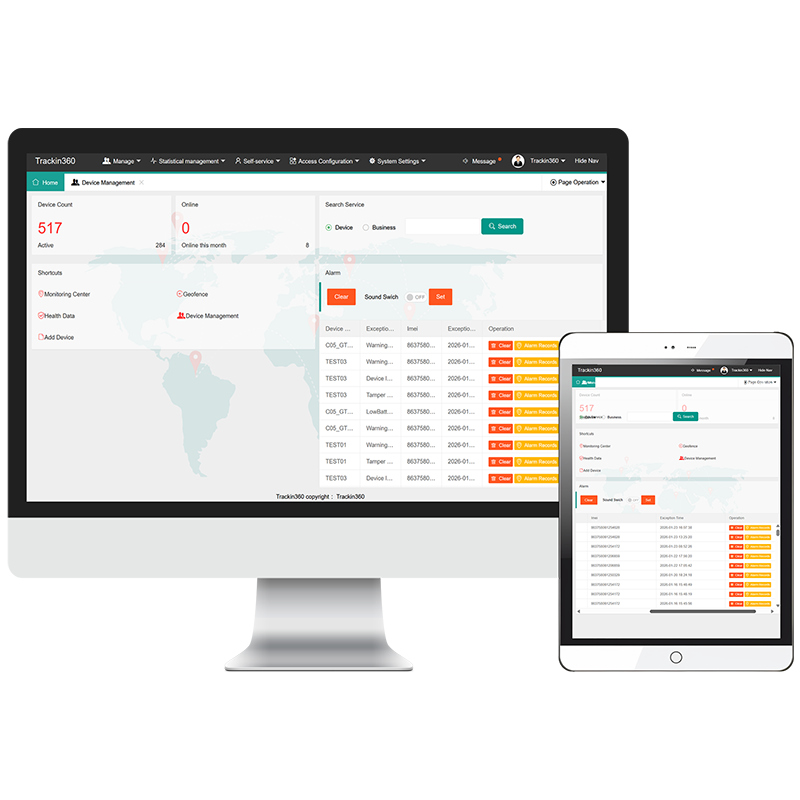
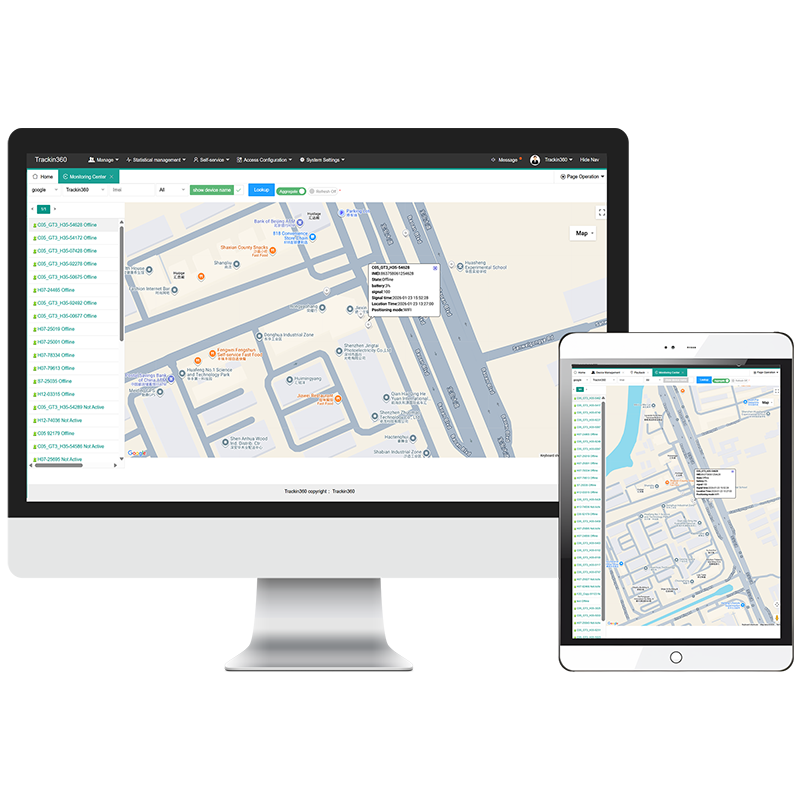
How does a GPS tracking system work?
Firstly, you can check on: How does GPS Work article to know the whole picture, then you can check the user manual of our tracking platform: Trackin360 Tracking GPS System User Manual.
-
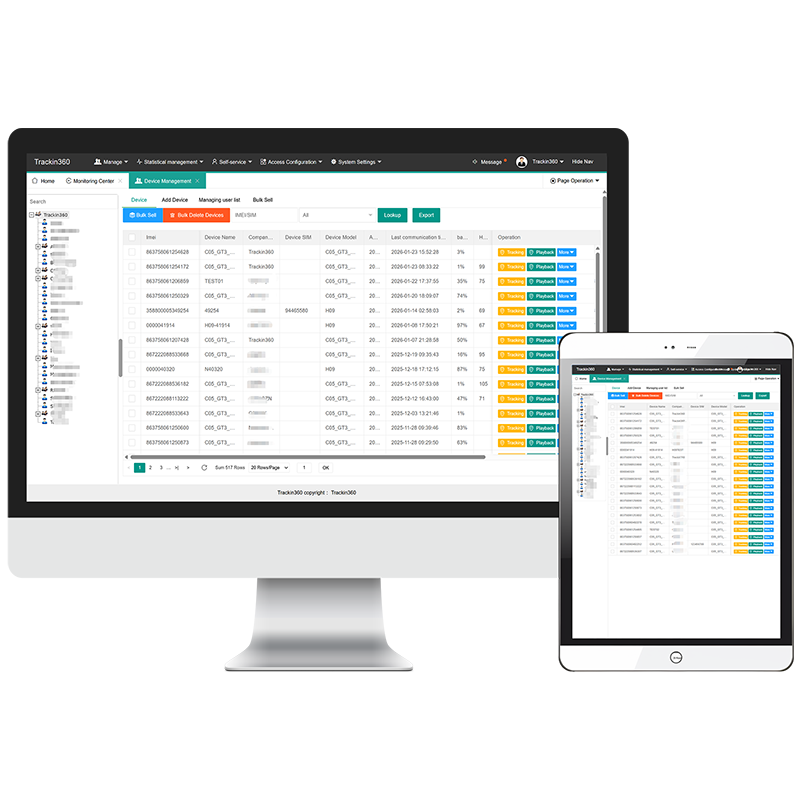
How do I add and manage a large number of devices in bulk on the web platform?
Our web platform supports bulk device addition via CSV file upload, significantly streamlining onboarding. You can then efficiently manage them using group filtering, batch editing, and assignment tools in the centralized device management module
-
What user roles and permissions can I set up for my team?
The platform offers granular Role-Based Access Control. You can define roles (e.g., Distributor, Sub-distributor, End User) with specific permissions for device groups, data visibility, and feature access, ensuring secure and organized team collaboration
-
Can I create custom Geofences and how do alert rules work for them?
Yes, you can draw custom circular or polygonal geofences on the map, the system triggers instant, configurable alerts via app pop-up/email/SMS when a device enters or exits these zones, enabling automated boundary monitoring.
-
What types of reports can be generated and exported?
The platform generates comprehensive reports: Location History, Alarm/Event Logs, Health Data summaries, and Device Status reports. All reports are exportable in PDF, Excel, or CSV formats for analysis and sharing.
-
How does the real-time tracking update frequency work, and can I adjust it?
Update frequency is configurable per device via the “Upload Interval” setting, you can balance real-time precision with battery life by setting intervals from seconds to minutes, tailored to specific monitoring scenarios.
-
Is historical route Playback available, and for how long is data stored?
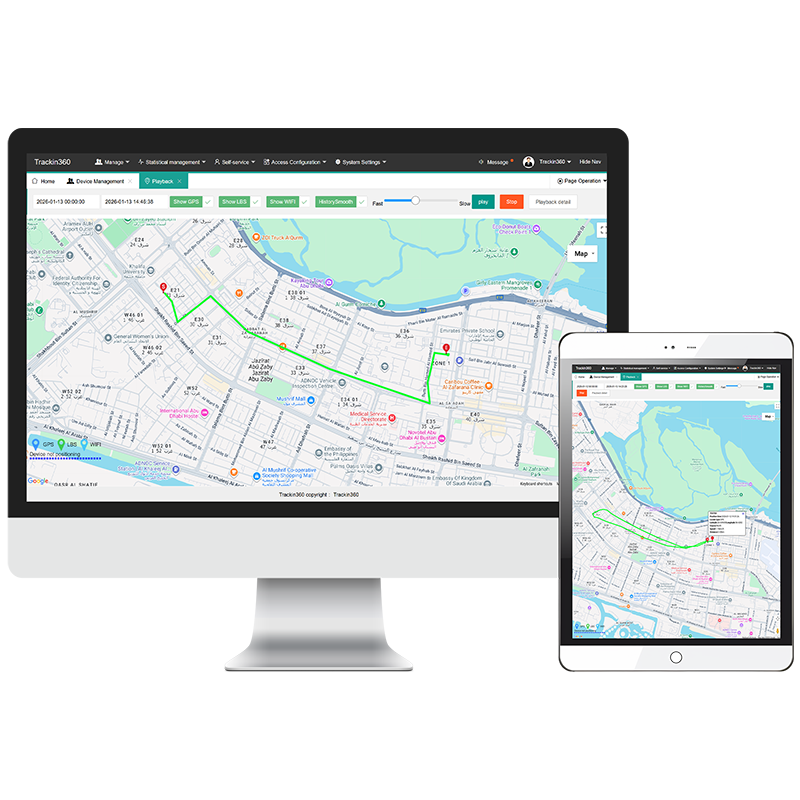
Yes, our Playback feature allows you to replay historical routes with timestamps and speed data, standard data retention is 3 months, if the system deploy on your own server, this data can be store as long as you want.
-
How do I set up and manage SOS alerts and emergency contacts in the APP?
In the device settings within the APP, you can configure the SOS function and designate maximum 3 emergency contacts, when the SOS button is pressed, the tracking GPS platform or app immediately alerts these contacts with the device’s live location.
-
Can I send direct text Messages or instructions to the device from the platform?
Yes, our platform features a built-in two-way messaging system, you can send text messages and predefined instructions directly to the device, and receive replies, facilitating seamless communication via internet and cellular network.
-
How are health data metrics displayed and analyzed?
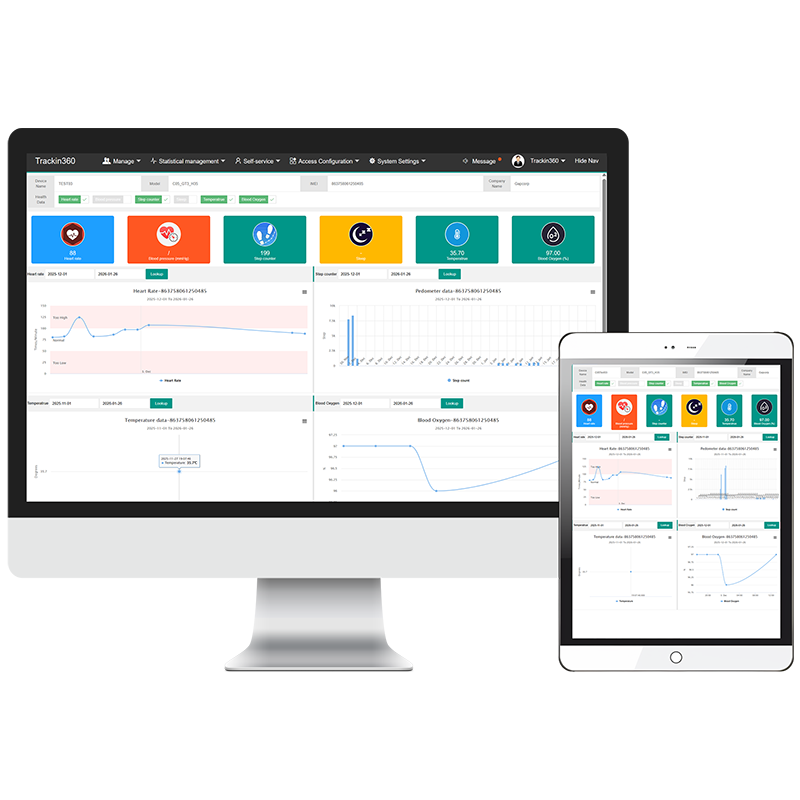
Health metrics (e.g., heart rate, blood pressure, blood oxygen pressure, temperature, pedometer) are displayed on the web GPS tracking platform and app consolidated into trend charts within the Health Data Report, this allows for easy tracking of wellness patterns over time.
-
What notification methods does the platform support?
The system supports multi-channel notifications: in-app alerts, email, and SMS, you can customize the delivery method for each alert type (geofence, SOS, low battery) in the Notification Center.
-
How do I remotely configure device parameters or update settings via the platform?
Through the “Device Instruction” or “Parameters Setting” function, you can remotely send configuration commands to update device settings like tracking modes, alert thresholds, and operational parameters without physical access.
-
Is two-way voice communication supported through the APP or web platform?
Yes, our solution supports two-way voice calls directly through the companion APP, enabling clear, instant communication between the platform user and the device wearer/carrier.
-
How can I filter and sort my Device List for efficient management?
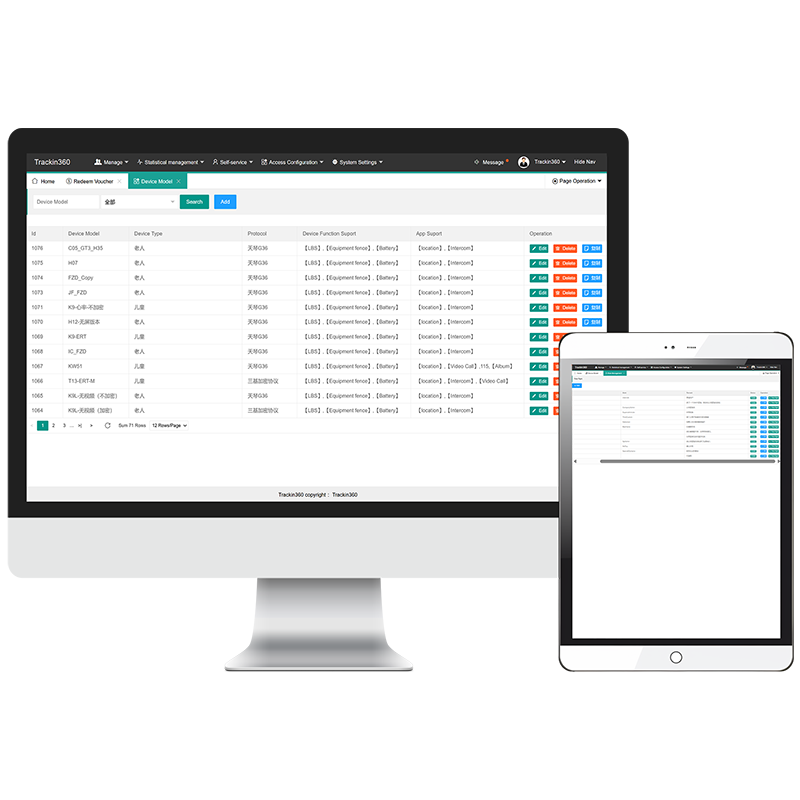
The Device List offers advanced filtering and sorting by status (online/offline), group, type, battery level, and more, this allows for quick identification and management of specific device subsets.
-
What happens if a device goes offline? How are offline events logged and reported?
The platform instantly marks the device as offline and can trigger an alert, all offline/online events are timestamped and logged in the Alarm Report and dedicated Offline Report for analysis.
-
Do you offer an API for integrating your platform data with our own systems?
Yes, we provide a comprehensive API, allowing you to seamlessly integrate location, alert, and health data into your own ERP, CRM, or command center systems for a unified workflow
-
Can the software platform be white-labeled or rebranded for our company?
Absolutely, we offer a complete white-label solution for the web platform and mobile APP, including custom branding, logos, color schemes, and domain, allowing you to present it as your own service.
-
Is the web platform accessible on mobile browsers, and is there a dedicated mobile APP?
Yes. Our web platform is fully responsive and works on any mobile browser. We also provide dedicated native iOS and Android APPs for optimized on-the-go monitoring and alert management.
-
How many languages does the platform interface support, and can we switch easily?
The platform and APP support over 10 interface languages, users can switch languages instantly from their profile settings, facilitating easy use by global teams and diverse workforces.
-
Can we create custom alert types or reporting formats to meet our specific needs?
For enterprise and custom solutions, we can develop custom alert logic and tailored report formats. Please contact our solution team to discuss your specific operational requirements.
-
How is user data secured and kept private within the platform?
We employ end-to-end encryption for data transmission, secure cloud storage with strict access controls, and comply with major data protection standards (like GDPR principles) to ensure total data security and privacy.
-
What is the process for requesting a new software feature for our custom solution?
Our custom development process begins with a consultation, you can submit a feature request to your dedicated account manager, and our product team will evaluate it for feasibility and provide a development roadmap.
-
How are software updates for the platform and APP deployed and managed?
Backend platform updates are deployed seamlessly by us with no action required from you, The Android and IOS tracking APP updates are released through official app stores; users can enable auto-update or install them manually.
-
Is there a way to manage multiple sub-accounts or client accounts under a main dealer account?
Yes, our platform includes a hierarchical account management system. Dealers or large enterprises can create and manage multiple independent sub-accounts or client tenants, each with isolated data and settings.
-
Can I export all user, device, and report data from the platform for backup or audit?
Yes, administrators have the ability to export comprehensive datasets — including full user lists, device inventories, and all report histories — from the platform’s management modules for backup or compliance audits.
-
How does the platform handle location accuracy from different positioning sources?
Our platform intelligently fuses data from multiple sources (4G, GPS, Wi-Fi) using proprietary algorithms to provide the most accurate possible location, automatically switching to the best available signal.
-
Is there a developer documentation or sandbox for testing API integrations?
Yes, we provide full, detailed API documentation (OpenAPI) and can provision a dedicated sandbox/test environment with simulated data for you to safely develop and test your integrations.
-
What kind of technical support is available for the software platform?
We provide dedicated technical support via email and ticket system for software-related issues. Standard support hours are 9am-6pm GMT+8 from Monday to Friday, with extended SLAs available for enterprise clients.
-
Can I set up automated, scheduled report generation and delivery via email?
Yes, out gps tracking platform’s reporting engine allows you to schedule any standard report (e.g., daily location summary, weekly health report) to be automatically generated and emailed to designated recipients at set times.
-
Does the platform support creating hierarchical groups for devices and users?
Yes, you can create a multi-level group structure (e.g., Region > Branch > Team) and assign devices and users to these groups, this enables efficient, scalable management and precise permission.










 Landscape