





Admin 2026-07-12 382
Usage-based insurance (UBI) is an innovative type of car insurance that breaks away from traditional pricing models. Traditional car insurance typically relies on static factors such as age, gender, and vehicle type for a rough price, while UBI's core concept is "pricing based on actual driving behavior and mileage." It collects real-time information about the driver's speed, braking frequency, and driving duration through on-board diagnostics (OBD) devices or a smartphone app, providing car owners with a personalized premium plan tailored to their individual needs and vehicle. The core logic is: The safer you drive and the fewer miles you drive, the lower your premium.
Based on different data collection methods and pricing logic, UBI is mainly divided into the following two types.
This primarily focuses on vehicle usage frequency and distance traveled. The less a driver drives, the lower the premium. This model is particularly suitable for drivers with short daily commutes and low vehicle usage.
This is currently the mainstream UBI model. It uses sensors or onboard devices to record detailed dynamic behaviors of the driver, such as rapid acceleration, sudden braking, sharp turns, speeding, and nighttime driving. The system scores these behaviors; the safer the driving habits, the larger the premium discount.
This is an advanced interactive mode. It not only prices based on behavior but also emphasizes process management. The system provides drivers with real-time feedback on driving behavior (such as in-app safety scores and emergency braking alerts) and even personalized driving improvement suggestions. Through this interaction, it subtly guides drivers to develop smoother and safer driving habits, thereby reducing accident rates.
UBI not only changes how premiums are calculated, but also brings significant positive value to the entire auto insurance ecosystem.
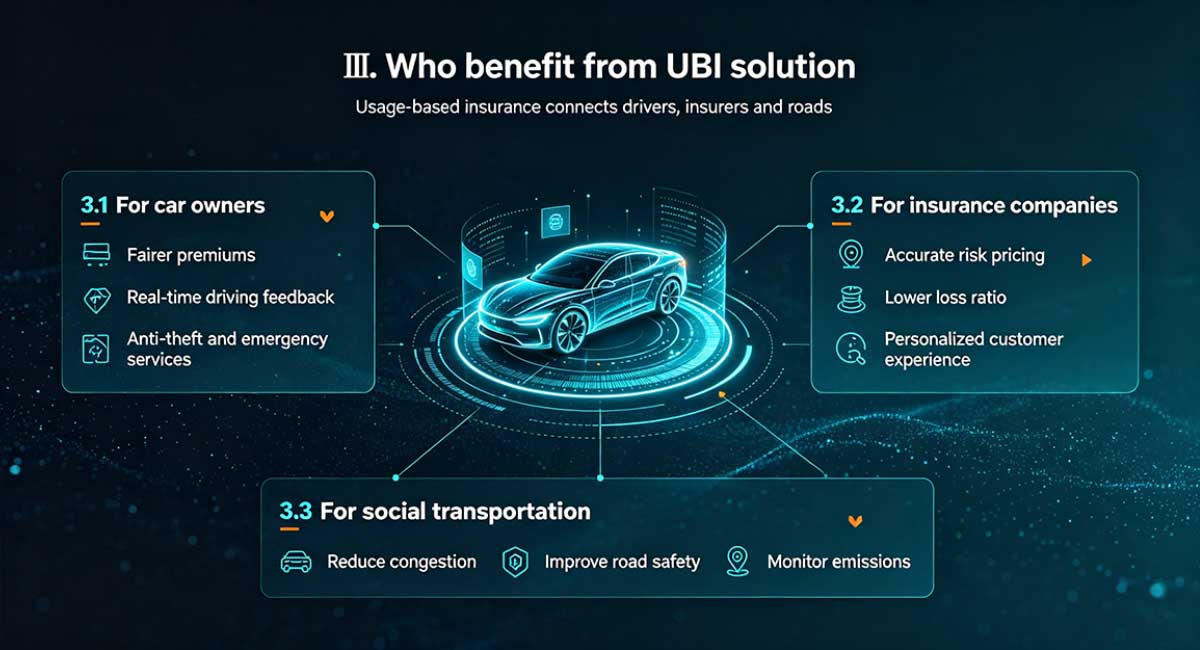
Fairer premiums: Safe drivers no longer "pay the price" for high-risk drivers; they can enjoy substantial premium discounts by cultivating good driving habits.
Improved driving behavior: Real-time feedback on driving behavior (such as in-app safety scores or emergency braking alerts) subtly guides car owners to develop smoother and safer driving habits.
Value-added service experience: UBI products typically include practical functions such as vehicle location tracking, anti-theft tracking, and emergency roadside assistance.
Accurate risk assessment: Through multi-dimensional dynamic data, insurance companies can more accurately identify customer risks, reducing the "adverse selection" problem caused by information asymmetry.
Reduced loss ratio: Overall improvement in car owner driving behavior directly reduces the incidence of traffic accidents, thereby effectively controlling claims costs.
Enhanced customer loyalty: Personalized pricing and interactive app experiences help improve customer satisfaction and retention rates.
Easing traffic congestion: The PAYD mode encourages reducing unnecessary travel, helping to reduce road load.
Improving road safety: Optimized overall driving habits make the road traffic environment safer.
Environmental protection: Real-time monitoring of vehicle exhaust emissions to reduce environmental pollution.
This is currently the most intuitive classification of UBI products, primarily determining how data is acquired from the vehicle. There are currently three main forms on the market.
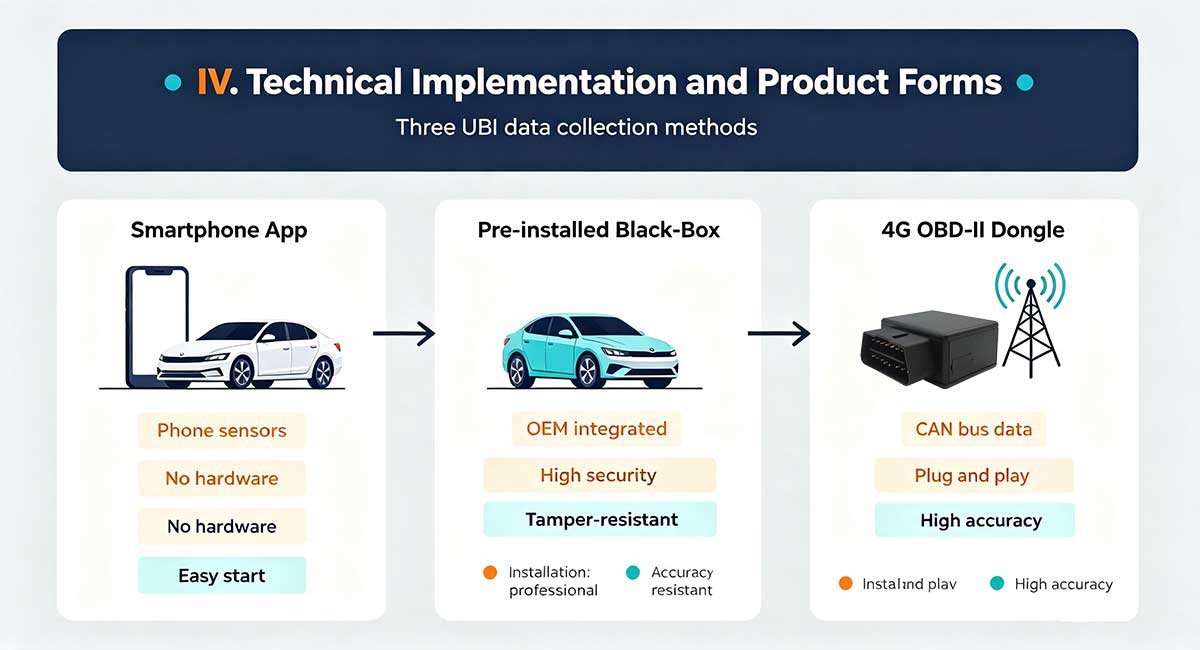
Car owners simply download a designated application to their phone and open it while driving. The app utilizes the phone's built-in sensors (such as GPS, accelerometer, and gyroscope) to record driving trajectories and behaviors.
Features: No additional hardware installation required, extremely low deployment cost, and low barrier to entry for users. However, due to the variable placement of the phone and limited sensor accuracy, its data accuracy is slightly inferior to the OBD solution.
This form is typically pre-installed by the car manufacturer (OEM) at the factory, or retrofitted by insurance company professionals in a concealed location within the vehicle.
Features: Deep integration of the device with the vehicle system, high data security, and difficulty in being removed or tampered with by the user. With the increasing prevalence of intelligent connected vehicles, this pre-installed solution is becoming increasingly common.
This is currently the most mature and accurate solution, and it's also Huatenglobal's main product and solution (click to know products). A small smart hardware box is inserted into the OBD (On-Board Diagnostics) interface below the steering wheel to directly read the vehicle's underlying CAN bus data.
Features: Extremely easy installation (plug and play), capable of acquiring the most accurate and fundamental vehicle operating data (such as engine speed, throttle position, braking force, etc.), with extremely high data accuracy.
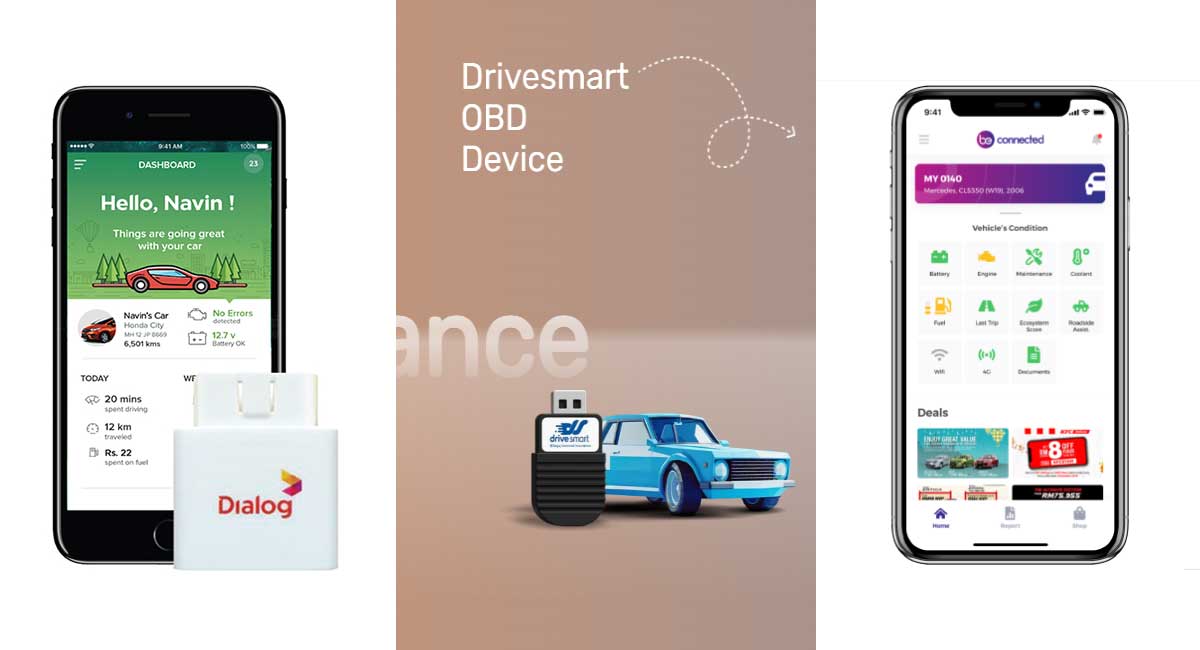
Bajaj Allianz is one of biggest insurance companies from India, it made greart succeed since 2016, first generation is 2G version VT200, then upgrade to 4G version V400, over 10 years business mode. More details check on: https://www.bajajgeneralinsurance.com/motor-insurance/drive-smart-obd-device.html
Dialig is one of biggest telecom operators from South Asia and Southeast Asia, they luanch the car insurance bundle with their SIM card data plan, more details check on: https://dialog.lk/news/Dialog-Launches-Car-Connect-an-On-Board-Diagnostic-OBD-device-and-Smartphone-app
ICICI Bank reforming their car insurance since 2020, with customize insurance service, help they won 7.5% increase car insurnces user. More details check on: https://www.icicilombard.com/motor-insurance/car-insurance/car-guide/blogs/how-to-use-an-obd2-scanner
We provide different types of OBD2 tracker, fit for fleet management, UBl, rental and leasing, etc. all kind of business.
2G tracking only: C08 OBD2 Tracker
4G tracking only: C11 OBD2 Tracker
4G tracking + diagnostic: VT400 OBD2 Dongle
4G/3G/2G tracking + disgnostic: VT400 OBD2 Dongle
Here example with VT400 OBD2 4G Dongle Tracker, then you can see what make it so outstanding.
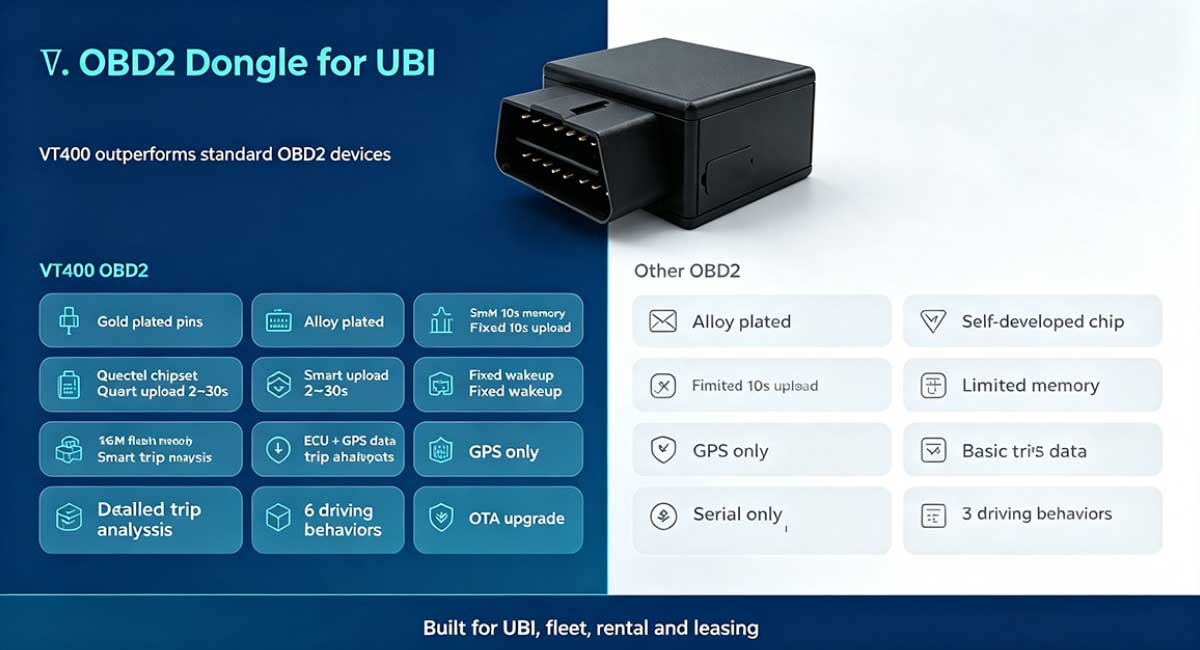
VT400 OBD2 pins with gold plated, btetter conductivity and stronger port, other OBD2 devices is galvanized alloy plated.
VT400 OBD2 uses Quectel module chipset, well-knowed brands, suitable for long-term continuous work, stronq anti-interference ability already passed CE, RoHS, FCC,PTCRB and others world mainshteam certificates, Other OBD2 devices use self-developed singlechip microcomputer, poor performance under some strict enwironment like high temperture, humid, etc.
VT400 OBD2 upload interval is ccording to the cuve ofturn, speed and angle and so on, 2~30s flexible not fixed, automatic compensationand high speed compensation algorithm ensure smoother route path, other OBD2 device are fixed 10s no matter the cuve, speed, angle.
VT400 OBD2 equipped 16M bytes extra flash memory, able to store over 14,000 pieces data in no signal area, but other OBD2 device onlyuse CPU spare room to store no siqnal area data cache around 3,000 pieces data only.
VT400 OBD2 support 6-hours regular. callinq, SMS, iqnition on, wibration, towing wake up method duning sleep mode, but duning first one hours, 30 min, 60 min, 120 min, 360 min detects cars' battery voltage, if drop too much, and it will send alert, if consumption normal, wilgoes into every 6 hours RTC. Avoid fotgot turn off light causes car's battery exhust in a night effectively. Other OBD2 not have this check.
Other OBD2 devices calculates mileages and fuel consumption by uses GPS data, but VT400 OBD2 device try to get those data from carsECU first, only while unable fetch, it ust use GPS data to calculate moleages and fuel consumption.
Other OBD2 devices support total trip's mileage, fuel consumption, driving behavior, etc. data, but VT400 OBD2 not only provide those basic data but also provides more details like over speed, high speed, medium speed, low speed status mileage, fuel consumption, driving behavior data and each part percentage, perfect match UBl anf fleet management giving score and rating requirement.
Other OBD2 devices support harsh acceleration, harsh deceleration and sudden braking 3 kind of driving behavior, but besides these 3 kind of driving behaviors, VT400 OBD2 also support sharp turns, sharp lanes changes and fatigue driving 3 kind more.
Other OBD2 devices support K-line upgrade and serial port upgrade two methods, but VT400 OBD2 also support OTA, very useful for fleet management cars upgrade.
With the continuous evolution of vehicle-to-everything (V2X) technology, the future form of UBI products is developing from single hardware data collection to a deep integration of "pre-installed hardware + cloud big data + AI actuarial model", thereby achieving more accurate risk pricing and richer personalized services.
 Landscape