





 Landscape
IP Protection Ratings is Not Permanent: Is Your GPS Tracking Device Truly Waterproof and Dustproof?
Admin 2026-07-16 445
"Waterproof," "dustproof," "IP67," "IP68"—these terms are ubiquitous in the product specifications for GPS trackers. But what do they actually mean? Can an IP67-rated device be submerged in water? Can an IP65-rated device be used during a torrential downpour? Why is it that some devices—despite being touted as "waterproof"—suffer water damage shortly after being put into use?
As an IoT manufacturer specializing in professional safety and health monitoring devices, I will provide you with a detailed breakdown of the true meaning behind IP protection ratings. My goal is to help you make informed decisions when selecting a device, thereby avoiding equipment damage caused by misunderstandings.
Ⅰ. What is an IP Protection Rating?
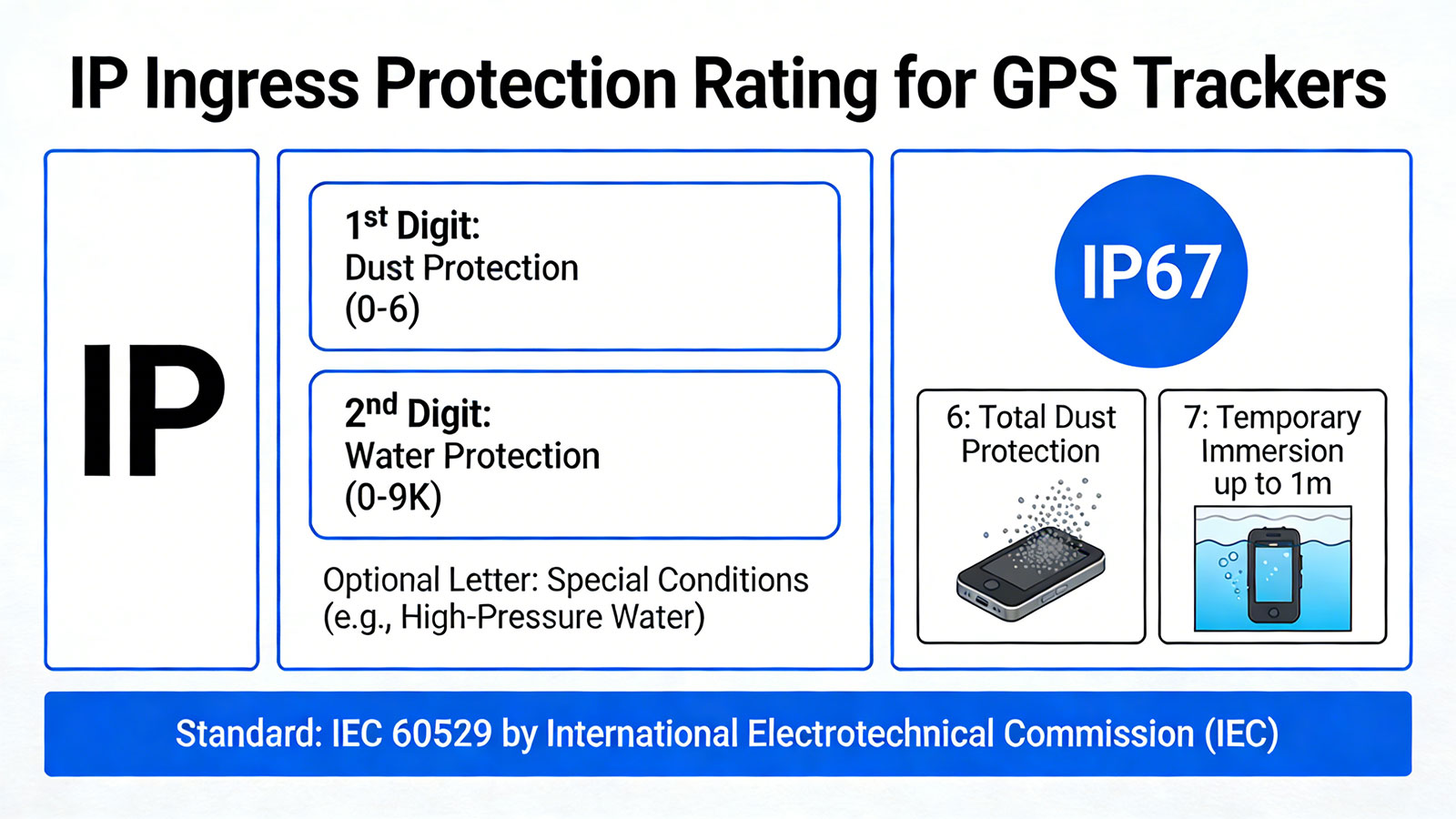
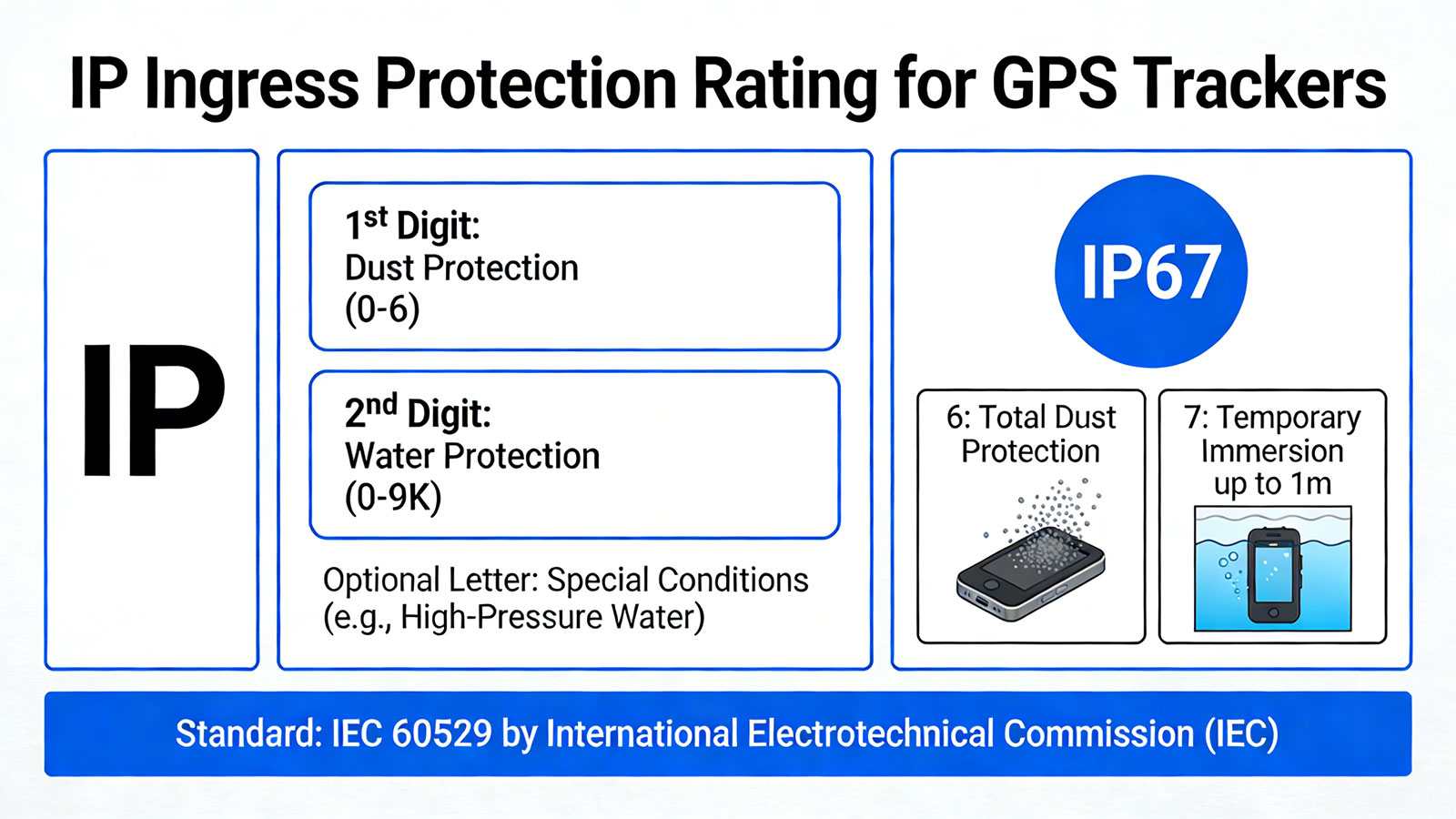
IP stands for Ingress Protection and is defined by the International Electrotechnical Commission (IEC) under standard IEC 60529. It is used to specify the degree of protection provided by the enclosures of electrical equipment against solid foreign objects (such as dust) and liquids (such as water).
IP Code Format: The letters "IP" are followed by two digits, and sometimes an additional letter.
First Digit: Dust protection level (0–6)
Second Digit: Water protection level (0–9K)
Additional Letter: Optional; indicates protection under specific conditions (e.g., high-pressure water jets)
For example: IP67 indicates complete dust protection (Level 6) + the ability to withstand brief immersion in water up to 1 meter in depth (Level 7).
Ⅱ. Explanation of Dust Protection Ratings (The First Digit)
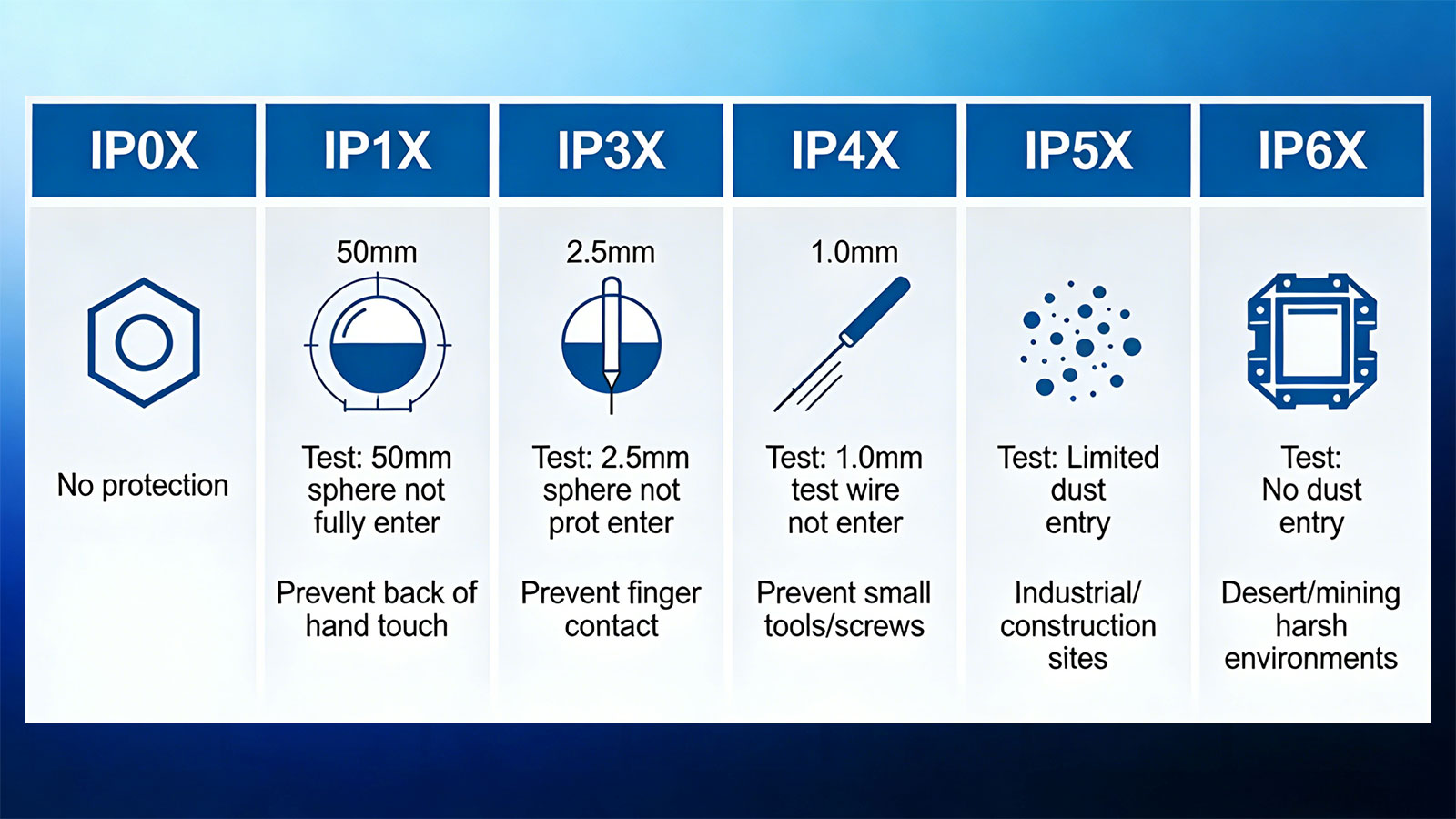
Dust protection ratings range from 0 to 6; the higher the number, the stronger the protective capability.
| Grade | Protection Level | Test Methods | Practical Significance |
| IP0X | IP0X | - | No Protection |
| IP1X | Protection against solid objects > 50 mm in diameter | 50 mm diameter sphere shall not fully enter. | Prevents accidental contact with the back of the hand |
| IP2X | Protection against solid objects > 12.5 mm in diameter | 12.5 mm diameter sphere shall not fully enter. | Prevents finger access to internal components |
| IP3X | Protection against solid objects > 2.5 mm in diameter | 2.5 mm diameter test rod shall not enter. | Prevents the entry of tools and wires |
| IP4X | Protection against solid objects > 1.0 mm in diameter | 1.0 mm diameter test wire shall not enter. | Prevents the entry of small tools and screws |
| IP5X | Dust-protected | Ingress of dust is not completely prevented, but the amount of dust entering shall not interfere with the normal operation of the equipment. | Common in industrial environments and construction sites |
| IP6X | Dust-tight | Complete prevention of dust ingress. | Essential in harsh environments such as deserts and mines |
Key Points
IP5X permits the ingress of a very small amount of dust, provided that it does not compromise functionality or safety.
IP6X represents the highest level of dust protection; it is completely sealed and suitable for use in extreme environments.
Ⅲ. Explanation of Waterproof Ratings (The Second Digit)
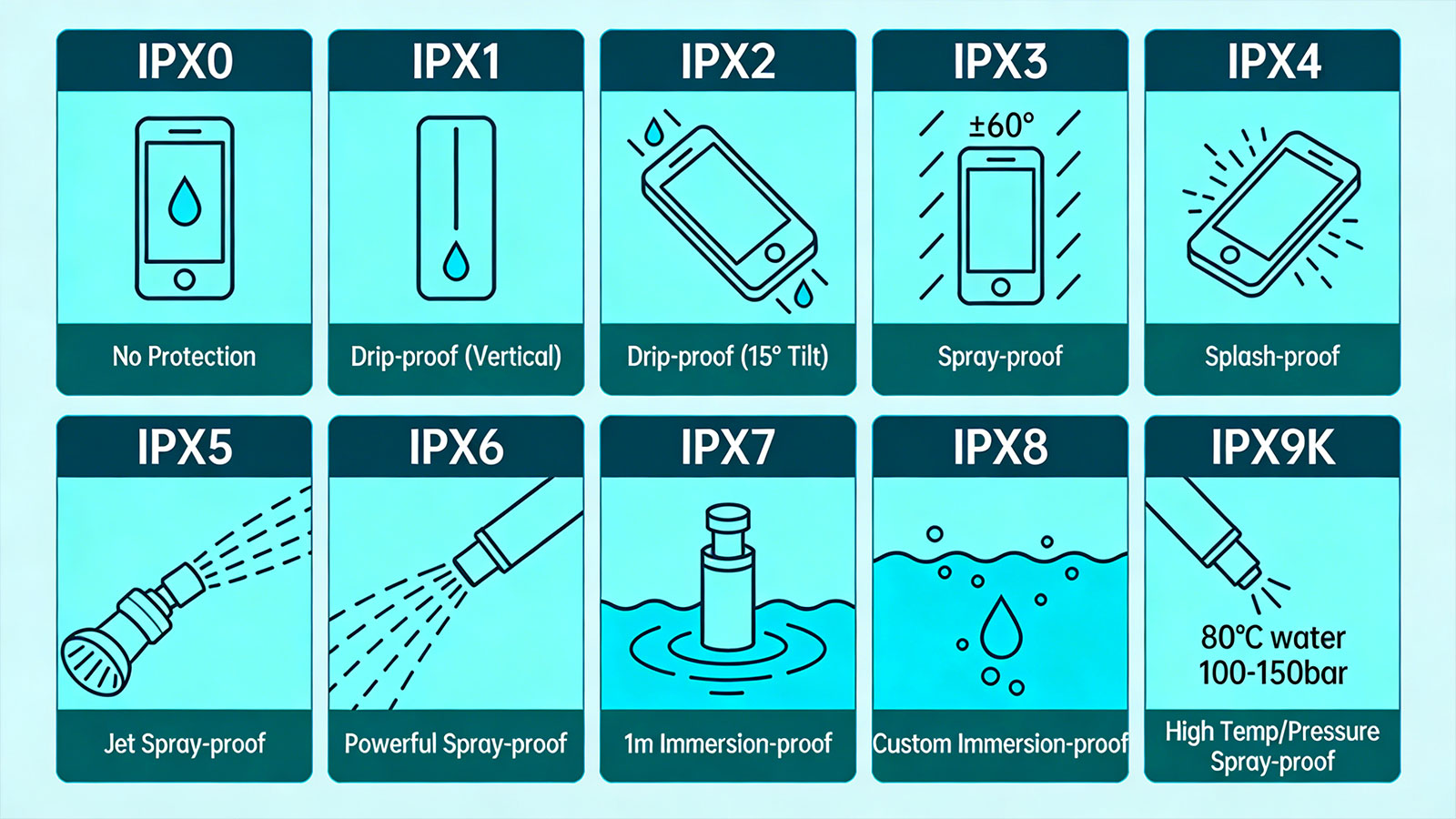
Water resistance ratings range from 0 to 9K; the higher the number, the greater the protection against water.
| Grade | Protection Level | Protection Level | Practical Application |
| IPX0 | No Protection | - | Any water contact causes damage |
| IPX1 | Protection against Vertically Dripping Water | Vertical dripping for 10 minutes (equivalent to a rainfall rate of 3–5 mm per minute) | Indoor, windless environment |
| IPX2 | Protection against Dripping Water (15° Tilt) | Protection against Dripping Water (15° Tilt) | Slightly inclined surfaces |
| IPX3 | Protection against Spraying Water | Spraying from within ±60° of the vertical axis, at a flow rate of 10 L/min, for 10 minutes | Light rain, rinsing |
| IPX4 | Protection against Splashing Water | Splashing from any direction, at a flow rate of 10 L/min, for 10 minutes | Moderate rain, sink splashes |
| IPX5 | Protection against Water Jets | Spraying from any direction using a 6.3 mm nozzle, at a flow rate of 12.5 L/min, for 3 minutes | Heavy rain, faucet rinsing |
| IPX6 | Protection against Powerful Water Jets | Powerful spraying from any direction using a 12.5 mm nozzle, at a flow rate of 100 L/min, for 3 minutes | Heavy waves, fire hose jets |
| IPX7 | Protection against Short-term Immersion | Immersion in water at a depth of 1 meter for 30 minutes | Accidental drops into water, shallow immersion |
| IPX8 | Protection against Short-term Immersion | Immersion at a depth and duration specified by the manufacturer (typically >1 meter, >30 minutes) | Swimming, diving (requires specific specifications) |
| IPX9K | Protection against High-Temperature, High-Pressure Water Jets | Protection against High-Temperature, High-Pressure Water Jets | Protection against High-Temperature, High-Pressure Water Jets |
Key Points
IPX7 tests for static immersion, not dynamic water flow or high-pressure jets.
IPX8 specifications must explicitly state the specific depth and duration—for example, "IPX8, 2 meters, 2 hours."
IPX5/6 and IPX7/8 represent distinct testing dimensions; a single device can satisfy both simultaneously (e.g., IP67 signifies compliance with both IP6X dust protection and IPX7 water protection).
Ⅳ. Common Protection Ratings for GPS Tracking Devices
Different types of trackers require varying levels of protection, depending on their deployment environment.
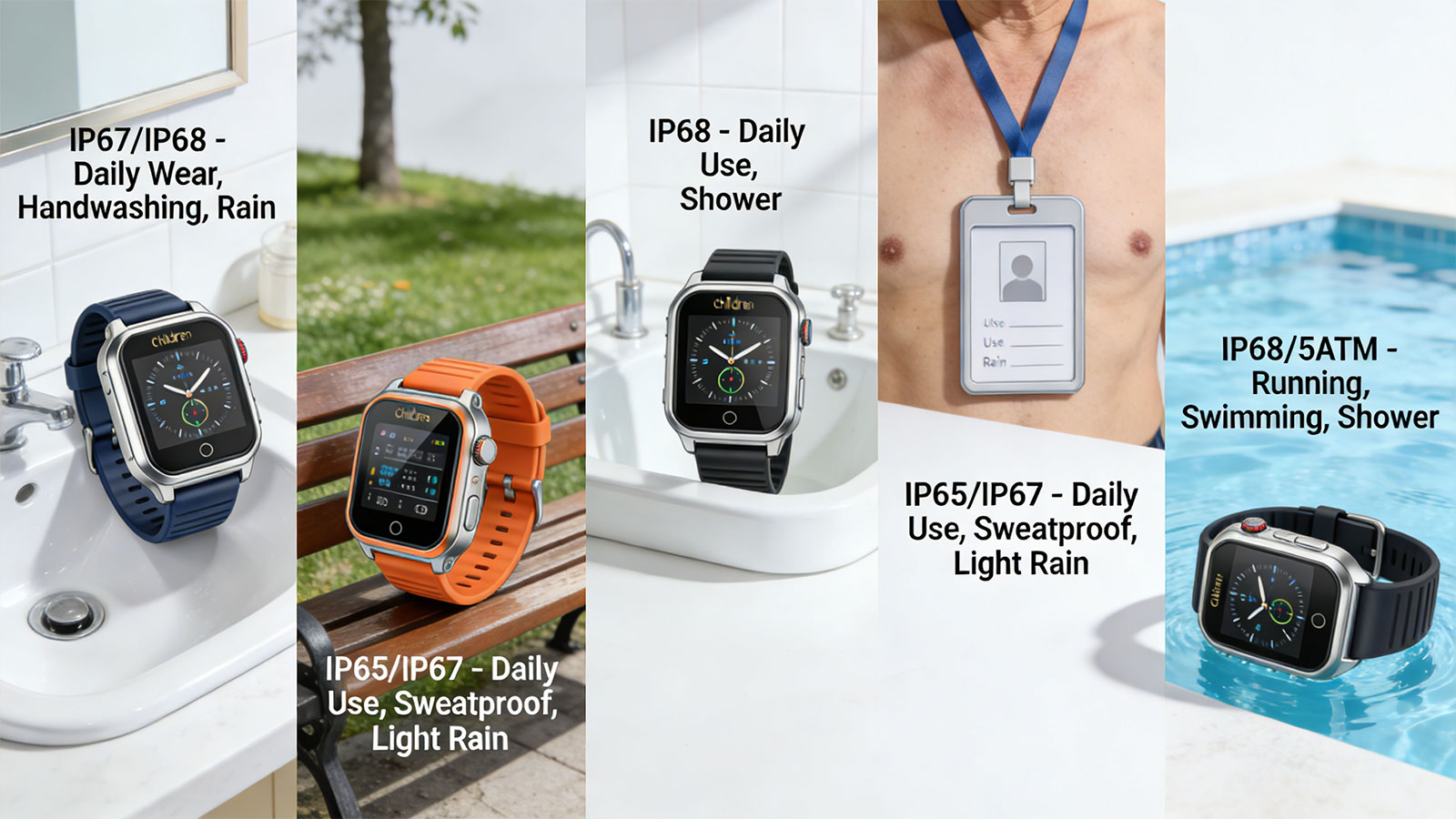
4.1 Personal Trackers (Watches, Badges, Pendants)
| Device Type | Recommended Protection Level | Applicable Scenarios | Description |
| Kids' GPS Watch | IP67/IP68 | Daily wear, hand washing, exposure to rain | Children may engage in water play and therefore require a higher level of protection. |
| Senior GPS Watch | IP65/IP67 | Daily use, sweat-resistant, light rain-resistant | The elderly typically do not intentionally wade into water, but precautions against accidental exposure are necessary. |
| Tamper-Proof GPS Watch | IP68 | Daily use, showering | The device cannot be removal; it must be suitable for use while showering. |
| Badge GPS Tracker | IP68 | Daily use, sweat-resistant, light rain-resistant | The elderly typically do not intentionally wade into water, but precautions against accidental exposure are necessary. |
| Smart Wristband | IP68/5ATM | Running, swimming, showering | Select models support use while swimming (please observe guidelines regarding water depth and duration). |
Real-world example: A children's smartwatch with an IP67 rating is fine if a child forgets to take it off while washing their hands (involving brief immersion); however, if worn during a bath (involving prolonged exposure, hot water, and water pressure), water intrusion may occur.
4.2 Vehicle Tracker
| Device Type | Recommended Protection Level | Applicable Scenarios | Description |
| OBD Interface | IP4X-IP5X | Interior Installation | Located within the cab; primarily serves to prevent dust and foreign objects, with low waterproofing requirements. |
| Magnetic and wireless | IP67/IP68 | Undercarriage, Chassis, Wheel Arches | Exposed to harsh environments; requires waterproofing and dust protection. |
| Hardwired | IP65-IP67 | Engine Bay, Chassis | Requires resistance to high temperatures, water, and oil/grease. |
Real-world Case: A strong-magnet tracker is installed on the underside of a vehicle. Its IP67 rating allows it to withstand driving in rainy weather and exposure to high-pressure water jets during car washes; however, it cannot withstand prolonged immersion in water.
4.3 Asset Tracker
| Device Type | Recommended Protection Level | Applicable Scenarios | Description |
| Industrial Assets | IP67/IP68 | Outdoor Equipment, Shipping Containers | Prolonged exposure to wind and rain |
| Cold Chain Tracking | IP67/IP68 | Refrigerated Trucks, Cold Storage Facilities | Requires protection against condensation and low temperatures |
| Cold Chain Tracking | IP68 | Wilderness, Swamplands, Snowy Terrain | Extreme environments require maximum protection |
4.4 Pet/Livestock Tracker
| Device Type | Recommended Protection Level | Applicable Scenarios | Description |
| Pet Collar Type | IP67/IP68 | Daily wear, exposure to rain, swimming | Pets may enter the water; requires high-level waterproofing |
| Cattle & Sheep | IP67/IP68 | Daily wear, exposure to rain, swimming | Cattle and sheep undergo daily showers; requires waterproofing |
Ⅴ. Common Misconceptions and Pitfalls
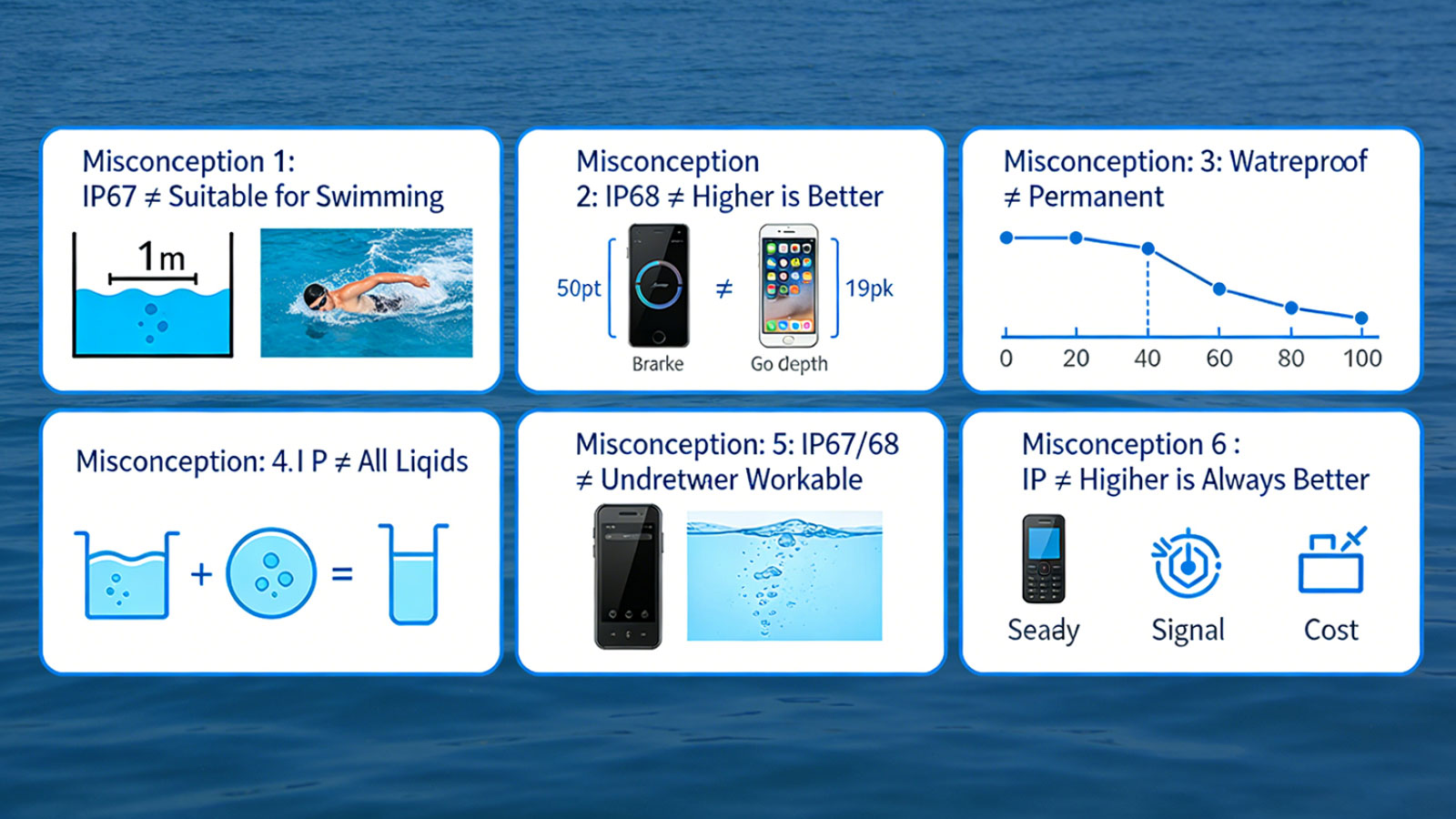
5.1 Misconception 1: IP67 = Safe for Swimming
Wrong.
IP67 certification only guarantees resistance to static immersion at a depth of 1 meter for up to 30 minutes. The dynamic water currents, pressure fluctuations, and impact forces associated with swimming or diving far exceed the testing conditions for IP67. Devices truly suitable for swimming require a rating of at least IP68 (specifically designated as swim-proof) or 5ATM (atmospheric pressure, equivalent to the static pressure at a depth of 50 meters).
5.2 Misconception 2: A Higher IP68 Rating Is Always Better
Not necessarily.
IP68 represents a broad category; the specific maximum depth and duration of immersion a device can withstand must be explicitly stated by the manufacturer. Some IP68-rated devices can only handle 1.5 meters for 30 minutes, while others can withstand 5 meters for 2 hours. Always pay close attention to the fine print.
5.3 Misconception 3: Water-Resistant = Permanently Waterproof
Water resistance degrades over time.
Aging rubber seals, minute deformations in the casing, or impact from drops can all compromise a device's protective integrity. An IP rating reflects the device's initial protective capability at the time of manufacture; it does not guarantee that the device will maintain that level of protection indefinitely.
5.4 Misconception 4: IP Ratings Cover All Liquids
Wrong.
IP testing is conducted using fresh water. Saltwater, chlorinated pool water, chemical solvents, oils, and other substances can corrode seals or penetrate the device more rapidly. If the device comes into contact with any of these liquids, it should be immediately rinsed with fresh water and thoroughly dried.
5.5 Misconception 5: IP67/68-rated devices can operate underwater.
Wrong.
IP ratings test for passive immersion—meaning the device remains stationary while submerged—and do not require the device to function normally while underwater. Wireless signals (Wi-Fi, Bluetooth, GPS, cellular) attenuate rapidly in water; consequently, most devices will lose their communication capabilities once submerged.
5.6 Misconception 6: A higher IP rating is always better, regardless of other factors.
A higher protection rating typically implies a thicker, heavier enclosure with tighter seals, which can lead to the following issues:
Poor Heat Dissipation: A sealed enclosure hinders heat dissipation, and elevated temperatures can damage internal components.
Signal Attenuation: A thick enclosure may weaken antenna signals.
Increased Cost: Higher protection ratings require more sophisticated design and more expensive materials.
The core principle for selecting a protection rating is this: choose a level that is sufficient for your needs; do not pursue excessive protection unnecessarily.
Ⅵ. How to Properly Use and Maintain Waterproof Device?
6.1 Pre-use Inspection
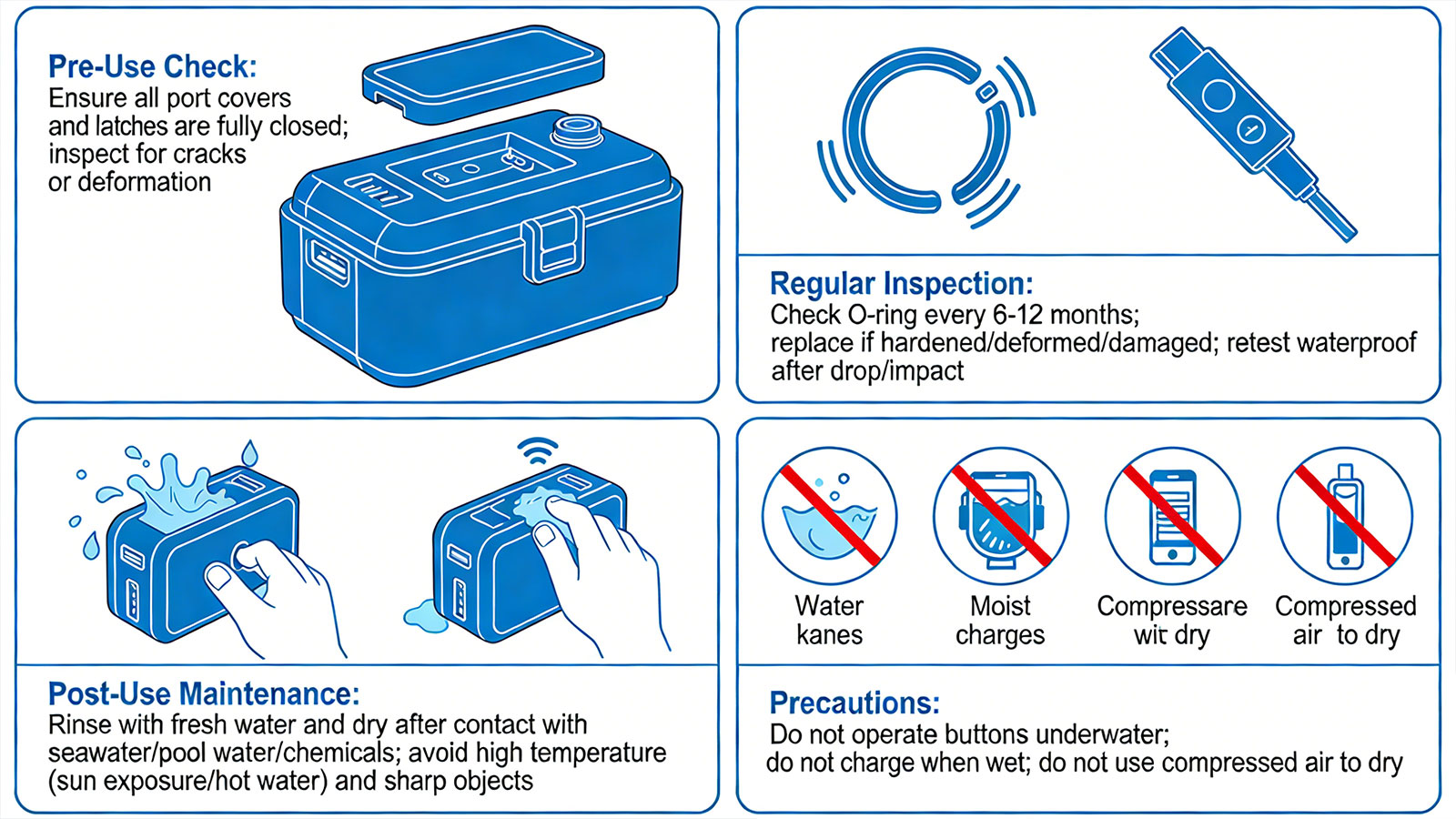
Verify that all port covers and latches are fully closed.
Inspect the housing for any cracks or deformation.
If any damage is found, immediately discontinue use and perform repairs.
6.2 Post-Use Maintenance
Immediately rinse with fresh water and wipe dry after contact with seawater, pool water, or chemicals.
Avoid high-temperature environments (such as direct sunlight or hot water), as high temperatures accelerate the aging of seals.
Avoid scratching the casing with sharp objects.
6.3 Periodic Inspection
Inspect the condition of the sealing ring every 6 to 12 months.
If the sealing ring is found to be hardened, deformed, or damaged, replace it immediately.
After a drop or impact, re-test the waterproof performance (a seal tester may be used).
6.4 Precautions
Do not operate the buttons underwater (this may disrupt the internal pressure balance).
Do not charge the device while it is wet (dry the interface first).
Do not use compressed air to dry the device (this may force water deeper into the unit).
Ⅶ. Enterprise Client Selection Guide
7.1 Selection Based on Deployment Environment
Deployment Environment | Minimum Recommended Level | Recommended Rating | Important Notes |
| Indoor, Dry | IP4X | IP54 | Primarily dust-proof |
| Urban Outdoor, Occasional Rain Exposure | IP54 | IP65 | Resistant to light rain and dust |
| Frequent Rain Exposure, Humid | IP65 | IP67 | Resistant to light rain and dust |
| Under-vehicle, Chassis | IP67 | IP68 | Must withstand high-pressure water jets |
| Coastal, High Salt Mist | IP67 | IP68 + Corrosion-Resistant | Requires additional anti-corrosion treatment |
| Underwater Operation (Fixed Depth) | IP68 (Specified Depth) | - | Specific parameters must be verified |
7.2 Balancing Protection and Performance
Signal Considerations: Metal enclosures offer superior protection but can shield wireless signals; plastic enclosures provide better signal transmission, though their protective capabilities may be slightly lower.
Thermal Considerations: High-power-consumption devices (such as 4G video transmission equipment) require careful attention to heat dissipation; fully sealed enclosures may lead to overheating.
Cost Considerations: The cost of an IP68-rated design is typically 20–50% higher than that of an IP67 design; selection should be based on actual requirements.
7.3 Contracts and Warranties
Suppliers are required to provide third-party IP testing reports, rather than relying solely on product specifications.
Clarify warranty terms: Is water ingress damage covered under warranty? Typically, it is not, unless proven to be the result of a sealing defect.
For large-volume purchases, random sampling for seal integrity testing may be requested.
Ⅷ. Huaten Global's Practices
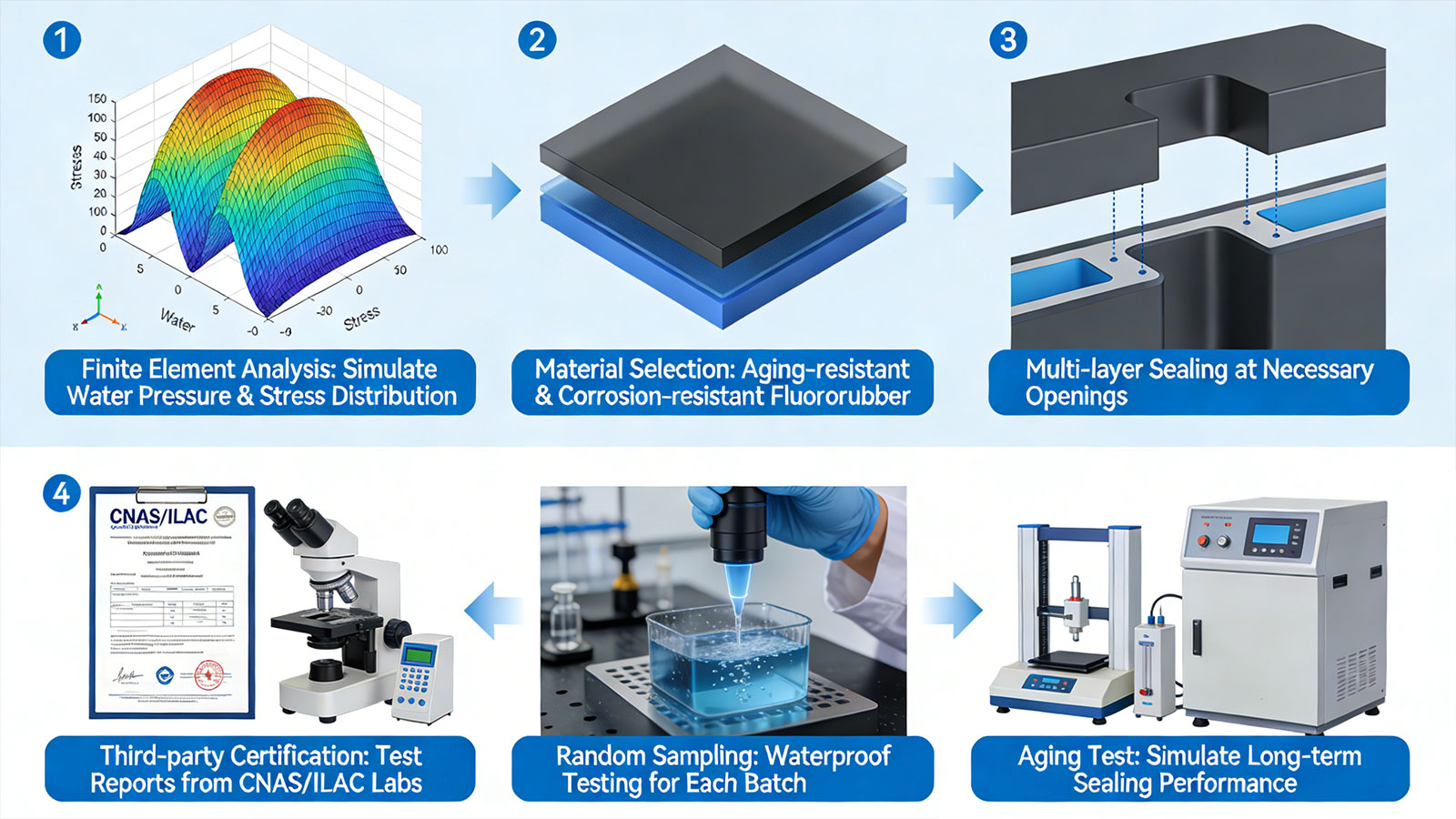
At Huaten Global, we maintain rigorous control processes regarding the ingress protection (IP) ratings of our products:
8.1 Design Phase
Simulation Analysis: Utilizing Finite Element Analysis (FEA) to simulate water pressure and stress distribution.
Material Selection: Choosing sealing materials that exhibit resistance to aging and corrosion (e.g., fluororubber).
Structural Optimization: Minimizing the number of openings wherever possible; for openings that are essential, a multi-layer sealing approach is employed.
8.2 Testing Phase
Third-Party Certification: All declared IP ratings are substantiated by test reports issued by CNAS/ILAC-accredited laboratories.
Sampling Inspection: Random samples are selected from each product batch to undergo waterproofing tests.
Aging Testing: Simulating sealing performance under conditions equivalent to long-term operational use.
Ⅸ. Summary
IP protection ratings serve as a valuable reference metric, but they do not offer a universal guarantee.
IP65: Completely dust-tight + resistant to water jets, but not suitable for immersion.
IP67: Completely dust-tight + immersion in water up to 1 meter deep for 30 minutes.
IP68: Completely dust-tight + immersion at a depth and duration specified by the manufacturer (be sure to read the fine print carefully).
Key principles for selecting a protection rating
1) Sufficiency is key: Choose a rating based on the actual deployment environment; do not feel compelled to pursue the highest rating unnecessarily.
2) Pay attention to details: For IP68 ratings, the specific depth and duration must be clearly defined.
3) Understand the limitations: Protective performance degrades over time; periodic inspections are required.
4) Holistic assessment: Balance protection requirements with factors such as signal strength, heat dissipation, and cost.
An IP67-rated GPS tracker can function normally in rainy weather and withstand accidental drops into water; however, it should not be worn while swimming, diving, or subjected to high-pressure water jets. By understanding these boundaries, you can ensure your device operates reliably for the long term.
If you have questions regarding the selection of protection levels for specific application scenarios, or if you wish to review third-party test reports for our products, please feel free to contact our technical support team.
Search
Previous
Next
Latest News
IP Protection Ratings is Not Permanent: Is Your GPS Tracking Device Truly Waterproof and Dustproof?
Is that Smartwatch Health Monitoring Medical Grade? - Focus on Trends, Not Medical Grade Disease Diagnosis Criteria
Battery Life Decoding: Seven Key Factors Affecting Your GPS Tracker Battery Duration
Is GPS Positioning Truly Real-Time? — The Truth About "Real-Time" GPS Tracking
Beyond Connectivity: What Your Tracker Can and Cannot Do When Cellular Networks Disappear?