





 Landscape

How small can a GPS tracker be? — The Limits of Miniaturization and the Technical Reality
Admin 2026-10-25 8
As a provider of 4G/5G cellular-based GPS tracking devices and solutions, we receive the same question from different customers every day like:
"How small can a smallest tracker be?"
"What is the smallest GPS tracker device available?"
"What is the world's smallest GPS tracker?"
"What are the smallest GPS trackers available on the market?"
"Where can I find a tiny GPS tracking device for pets?"
Behind this question lies a common ambition: asset management platforms seek tags small enough to be attached to equipment without being noticed, kids and elderly care providers want to have a small GPS tracker badge or watch for personal safety, pet brands aim to create lighter collar-mounted trackers affordable even for small size pets. Consequently, size has become the primary factor determining the competitiveness of IoT hardware devices. How Does a GPS Tracker Works?
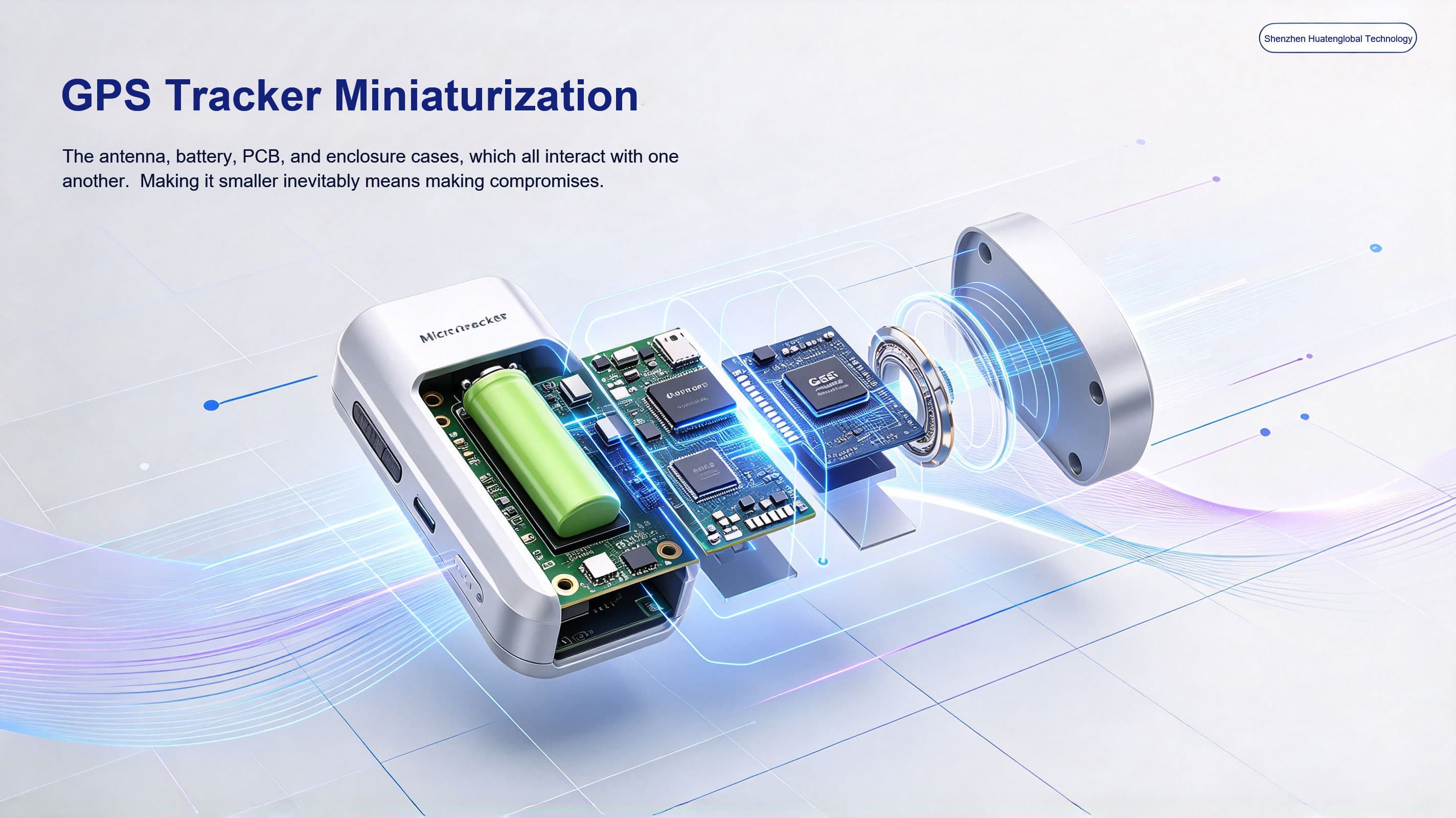
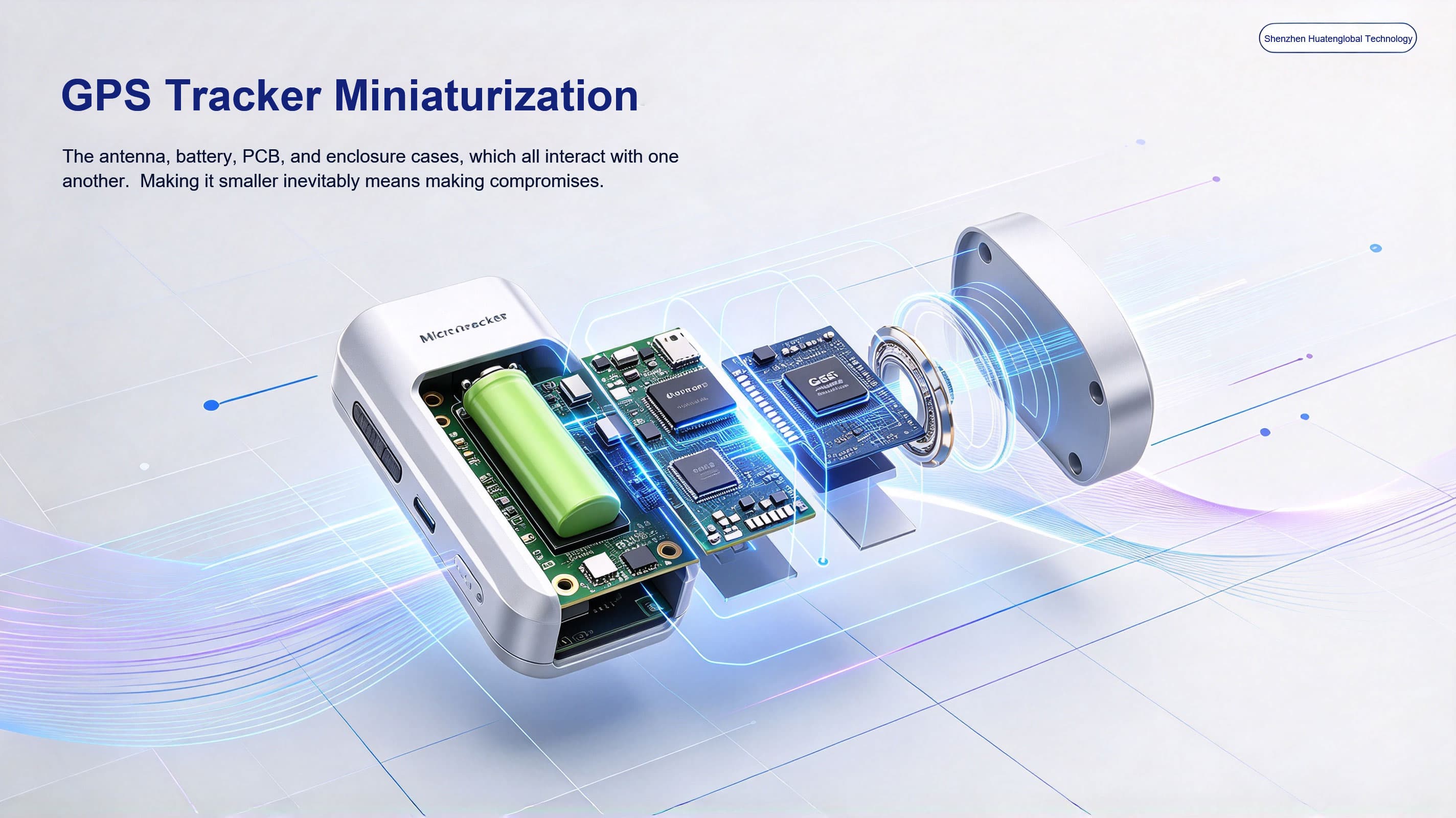
But "smallest" is never just a simple number. On the surface, these questions about size, but real is asking: Where are the limits of your engineering capabilities? The laws of physics don’t lie — the minimum size of a GPS tracker is determined by four hard constraints: the antenna, battery, PCB, and enclosure cases, which all interact with one another.
"How small can a smallest tracker be?"
Our answer is, the minimum size of a GPS tracker is determined by four hard constraints: the antenna, battery, PCB, and enclosure cases, which all interact with one another. Making it smaller inevitably means making compromises.
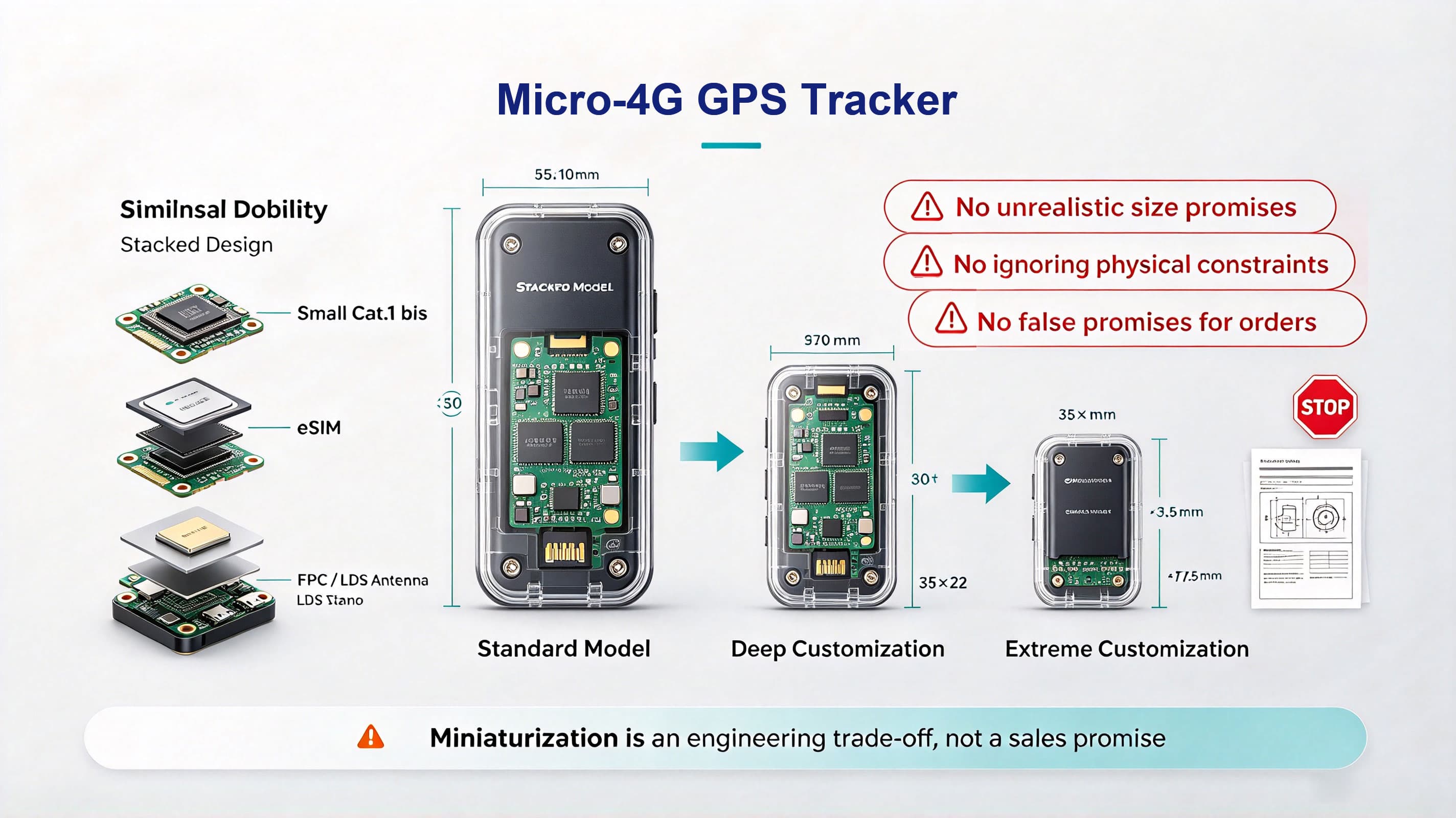
Standard Models (No Customization Required): The smallest 4G real-time GPS tracker we can provide measures approximately 55×30×10 mm;
Deep Customization (adjustments to antenna/battery/structure): Can be reduced to a minimum size of approximately 35×22×7.5 mm;
Extreme Customization (sacrificing battery life/accuracy/water resistance): We can work with the customer to evaluate even smaller designs, but acceptable performance trade-offs must be clearly defined before the project begins.
I. The Four Major Physical Constraints Determining the Size of a GPS Tracker
A 4G GNSS tracker capable of stable operation must include: GNSS antenna, 4G cellular antenna, 4G cellular module, GNSS receiver, battery, SIM card/eSIM, power management circuitry, sensors (motion, temperature, and health-related sensors), enclosure case and so on. These components define the lower limit of the device's physical dimensions. To make a 4G GPS tracker as smaller as possible, the first need to figure out is: What components are "taking up space"? Which ones can be scaled down? Which ones cannot?
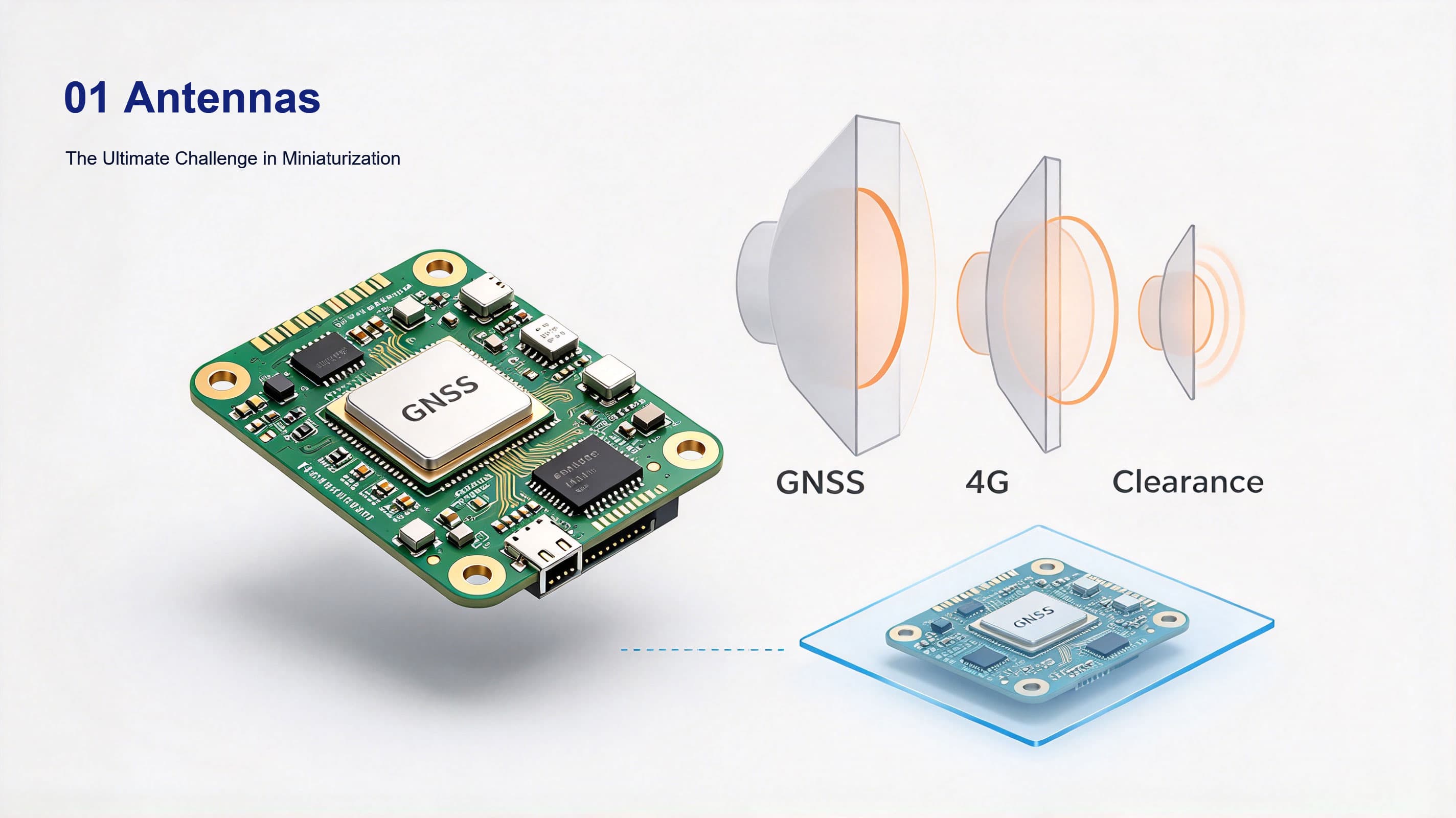
1.1 Antennas — The Ultimate Challenge in Miniaturization
GPS trackers require two types of antennas: a GNSS antenna to receive satellite signals and a 4G cellular antenna to send and receive data from cell towers. These are not "optional", but physical necessities.
| Antenna Type | Antenna Size | Performance |
| Standard Ceramic Antenna | 25×25×4mm | Excellent |
| Medium-sized ceramic antenna | 18×18×4mm | Good |
| Small ceramic antenna | 12×12×4mm | Usable, but sensitivity is reduced |
| Miniature ceramic antenna | 9×9×4mm | Bad, A-GPS assistance is required. |
Reducing the size of the antenna directly results in: slower satellite acquisition, GPS position drift, 4G network disconnections, and reduced performance in indoor and urban canyons. For ceramic antennas smaller than 9×9 mm, the time to first fix (TTFF) deteriorates significantly, and they are virtually unusable in scenarios where signals are obstructed. This is a hard limit dictated by the laws of physics.
1.1.1 Is it possible to use an antenna other than a ceramic GNSS antenna?
Yes, but the price is performance. Flexible printed circuit (FPC) antennas and printed circuit board (PCB) on-board antennas can be "integrated" into the curved surfaces of the housing or the motherboard's circuit traces, eliminating the need for the three-dimensional space required by ceramic antennas. However, their gain is typically 3–6 dB lower than that of ceramic antennas — effectively halving the signal strength. In low-signal environments such as indoors near a window or in urban canyons, the difference shifts from "whether positioning is possible" to "whether positioning can be achieved." Therefore, ceramic antennas are the preferred choice for in-vehicle trackers operating at high speeds or for GPS devices with less stringent size requirements; conversely, wearable devices like fitness bands and smartwatches, which have extremely tight size constraints, almost exclusively use FPC flexible antennas and PCB-mounted antennas.
1.1.2 4G antennas also take up a significant amount of space.
Real-time location reporting requires a 4G cellular connection. Because LTE operates across a wide range of frequency bands, it is more difficult to miniaturize the necessary broadband antennas. While single-band antennas can be made quite compact, multi-band, "all-network-compatible" 4G antennas are much harder to shrink. Furthermore, cellular antennas require a specific "clearance zone": typically necessitating a 5–10 mm gap free of any metal components, must maintain a certain degree of isolation from GNSS antennas, meaning they cannot be placed arbitrarily close to one another. Consequently, even if the antenna itself is miniaturized, the space required around it remains a rigid constraint.
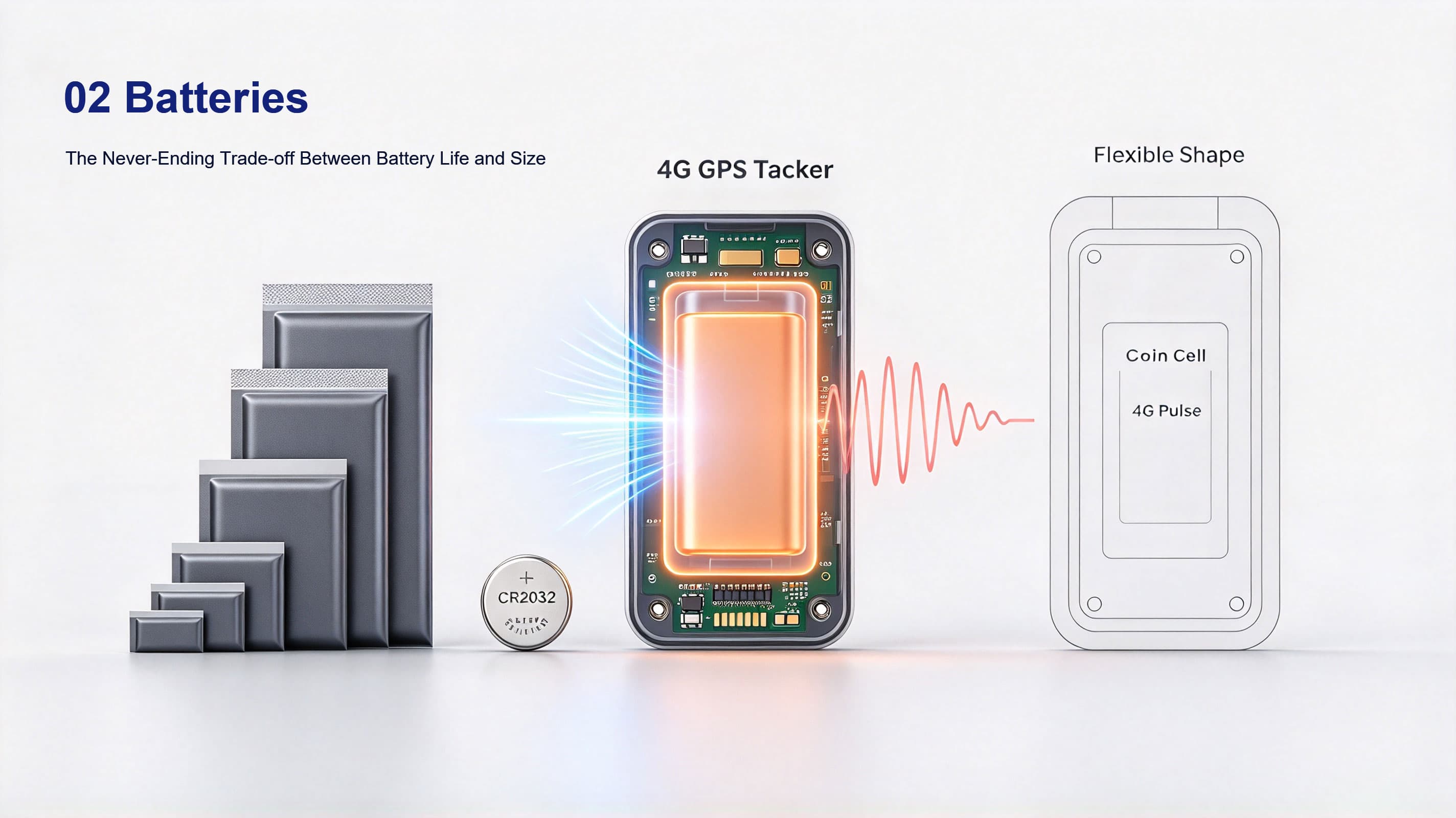
1.2 Batteries — The Never-Ending Trade-off Between Battery Life and Size
If the antenna can be likened to the brain, then the battery is the heart. It is often the single largest component within the entire device.
1.2.1 Battery size directly determines battery life
Take a common 4G location reporting scenario (reporting a location once per hour) as an example:
| Battery Type | Capacity | Size | Battery life |
| CR2032 coin cell battery | ~220mAh | Φ20×3.2mm | Supports BLE tags only; cannot power 4G functionality |
| Lithium polymer battery (extra small) | 80-120mAh | 15×12×5mm | Approximately 4–8 hours in 4G mode |
| Lithium polymer battery (small) | 200-300mAh | 20×15×6mm | Approximately 1–2 days in 4G mode |
| Lithium polymer battery (medium) | 500-800mAh | 30×20×8mm | Approximately 3–5 days in 4G mode |
| Lithium polymer battery (large) | 1000-1500mAh | 40×25×10mm | Approximately 5–8 days in 4G mode |
1.2.2 Why do most mini GPS trackers use lithium-ion batteries?
The main reason is that, for extremely compact devices, lithium-ion batteries offer the best overall combination of energy density, discharge characteristics, size flexibility, and the ability to be recharged and reused multiple times.
Energy Density
Lithium-ion batteries store significantly more electrical energy per unit volume than alkaline dry cells and nickel-metal hydride (NiMH) batteries. For the same volume, a lithium-ion battery can have 2 to 3 times the capacity of a NiMH battery. High energy density means: longer runtime for the same size, or a smaller size for the same runtime.
Discharge Characteristics
Dry cell batteries and standard button cells (such as CR2032) have high internal resistance and cannot sustainably deliver large pulse currents. Once the locator wakes up to dial out and upload its location, the voltage drops rapidly, directly causing the module to reboot and resulting in a failed location update. Lithium batteries have low internal resistance and can stably deliver large instantaneous currents, making them a perfect match for the 4G+GNSS periodic wake-up and reporting operating mode.
For example, during a single positioning and reporting cycle, a 4G Cat.1 module can draw instantaneous currents as high as 600–800 mA. Button cells not only lack sufficient capacity but also cannot withstand such peak discharge demands. Therefore, for any tracker requiring "real-time 4G reporting", the minimum battery capacity must be approximately 80–100 mAh for a lithium-polymer battery—a requirement that inherently dictates a minimum thickness of at least 5 mm in one dimension.
Dimensional Flexibility
GPS tracker housings are typically non-standard rectangles with irregular internal spaces. Lithium-polymer pouch batteries can be cut to custom thicknesses and shapes—such as ultra-thin (3–8 mm) or irregular profiles—to fit the interior space of the housing, thereby maximizing the use of the housing’s volume. In contrast, cylindrical lithium batteries and coin cells have fixed, standard shapes, resulting in poor space utilization within the housing and making it difficult to produce ultra-thin models.
Rechargeable capacity
Most IoT locators designed for safety and health applications are reusable products. Lithium-ion batteries support hundreds of full charge-discharge cycles and, when paired with a power management chip, enable wireless USB charging. Disposable dry-cell batteries, on the other hand, require frequent removal and replacement, which is incompatible with sealed, waterproof designs (such as IP67 protection).
No other battery technology on the market is better suited than lithium-ion batteries in terms of extremely compact size, high energy density, high-pulse discharge capability, customizable non-standard shapes, and rechargeability.
1.2.3 Two possible solutions
Low-frequency reporting strategy: Switch from hourly reporting to reporting a few times a day, relying on a small battery to sustain the device. This is acceptable for asset tracking scenarios.
Battery-free/NFC power-harvesting solution: The device itself has no battery; it draws power momentarily when touched by an NFC-enabled phone and reads the last cached location. However, this is not "real-time positioning", it can only be called "location read points".
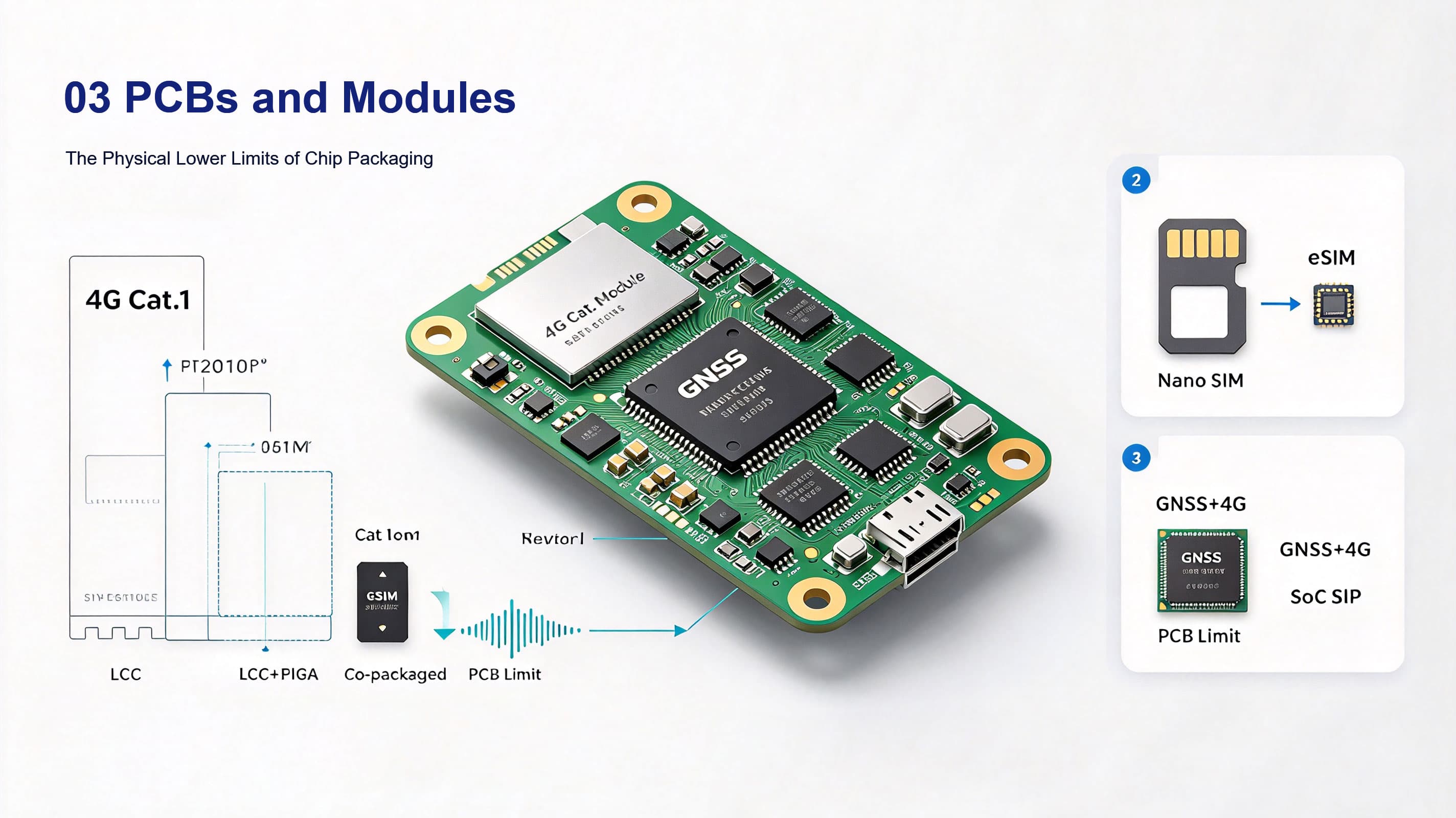
1.3 PCBs and Modules — The Physical Lower Limits of Chip Packaging
1.3.1 Size Comparison of Mainstream 4G Cat.1 Modules
As of 2025–2026, the smallest available 4G Cat.1 bis positioning modules feature a footprint of approximately 13 × 11 mm. When peripheral circuitry such as power management ICs, GNSS chips, sensors, and charging circuits, etc. the total size of the main circuit board is typically at least 20 × 15 mm:
| Modules | Package dimensions | Remark |
| Standard LCC-packaged 4G modules | Approx. 17.6 × 15.9 mm | Requires external circuitry |
| Compact LCC+LGA-packaged modules | Approx. 15.0 × 13.0 mm | Relatively compact |
| Ultra-compact Cat.1 modules | Approx. 13.8 × 11.1 mm | Latest solution |
When peripheral circuits (power management, GNSS chip/integrated GNSS, SIM card slot or eSIM pads, sensors, and charging circuitry) are included, the total area of the main board is typically no less than 20 × 15 mm.
1.3.2 Two key decisions that affect dimensions
eSIM vs. Nano SIM slot
The Nano SIM card slot itself measures approximately 12×9 mm; when combined with the thickness occupied by the insertion and removal mechanism (approximately 2.5–3 mm), this is quite “luxurious” for micro-devices. Switching to an eSIM module (a soldered eUICC chip, with a package as small as 2×2 mm or 3×3 mm) can significantly save space in the X and Y directions and reduce thickness along the Z-axis. The trade-off is reduced flexibility in switching carriers—but since B2B devices in large volumes are typically tied to a single carrier, this trade-off is acceptable.
Are the GNSS antenna and 4G module integrated into a one package
If a separate GNSS+4G solution (using two independent chips) is adopted, the PCB area will inevitably be larger. Opting for a GNSS+4G co-packaged SoC or SiP (System-in-Package) solution allows both positioning and communication to be handled on a single chip, significantly reducing the mainboard area. Some manufacturers have already introduced such solutions, with module sizes as small as 10×10 mm; however, cost and supply stability need to be evaluated.
1.4 The Enclosure case — The "Final Millimeter" of Industrial Design
Once the three main components—the antenna, battery, and PCB — are stacked together, the casing is the final constraint added. It doesn't just "wrap them up"; it must also provide protection against water, drops, and impacts in real-world, everyday use scenarios.
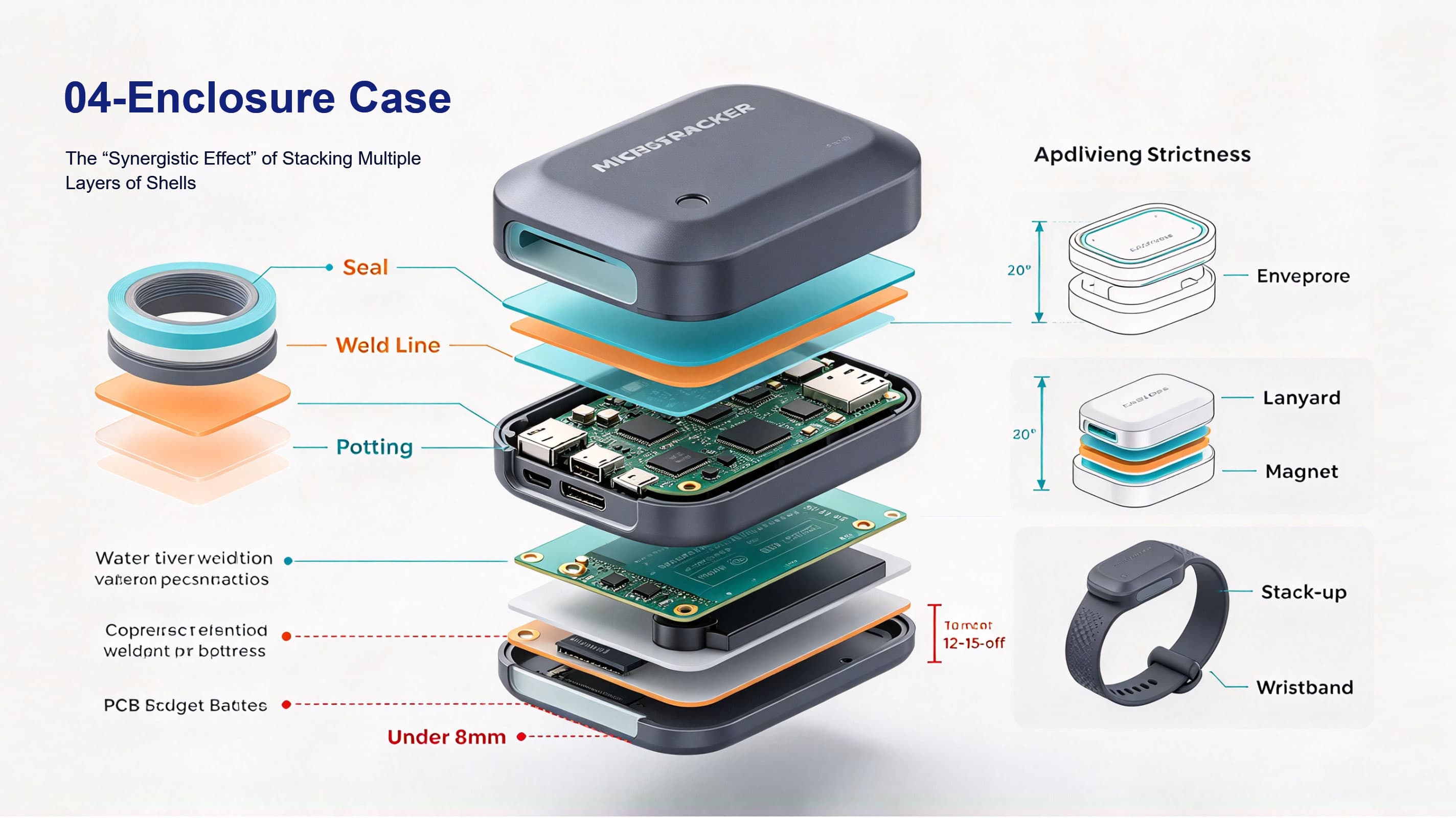
1.4.1 Strict Thickness Requirements for Waterproof
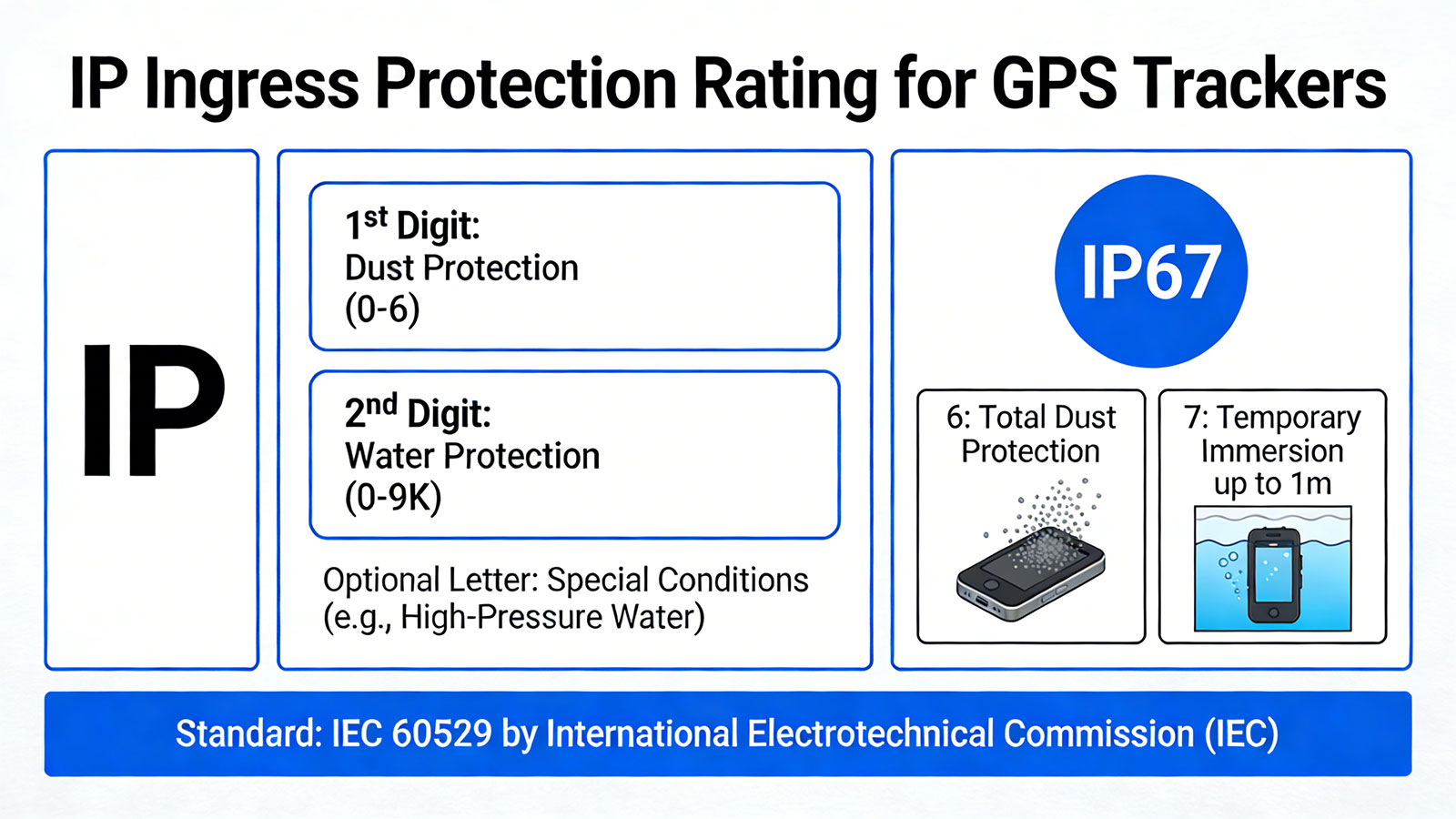
If a product requires an IP67 waterproof rating, the sealing structure itself requires additional thickness. Ultrasonic welding requires a certain width for the weld line; O-ring seals require compression space; and the potting process adds 0.5–1 mm to the wall thickness. For an IP67-rated micro-positioner, the thinnest part of the housing is typically no less than 1.2 mm (to account for drop resistance); if ultrasonic welding is used, it must be even thicker. These "invisible thicknesses" are often overlooked by customers without an engineering background.
1.4.2 Engineering Trade-offs in Wearing Methods
Lanyard hole/pin clip: Requires additional structural reinforcements, adding 1–2 mm to the local thickness.
Magnetic base: Magnet + magnetic shielding plate with a minimum thickness of 1.5 mm.
Embedded wristband/necklace: The housing must be contoured to fit; dimensions in the X and Y directions may increase.
1.4.3 The "Synergistic Effect" of Stacking Multiple Layers of Shells
Even with just a basic stack of the antenna, PCB, battery, and top and bottom casings — without any special optimization — the thickness already reaches the 12–15 mm. Reducing the thickness to under 8 mm would require sacrificing at least two of the following: antenna type, battery capacity, or water resistance rating.
In a Summary, smaller dimensions inevitably lead to shorter battery life, reduced RF sensitivity, higher costs, and fewer available features. It is physically impossible to create a device that is both ultra-compact and capable of supporting universal network compatibility (all-network access), high-precision positioning, long standby time, and robust environmental protection. Consequently,
A 4G real-time tracker the size of a "button" (less than 20mm in diameter and under 5mm in thickness) is currently unachievable under the constraints of the laws of physics.
The minimum size of a 4G GNSS GPS tracker is not a fixed number but rather the result of a series of engineering trade-offs. During the project initiation phase, the most prudent approach to product development is to first clarify the application scenarios and core performance metrics, and then determine the device's physical dimensions.
II. Current Level of Miniaturization in the Industry: Verifiable Figures for Mass Production
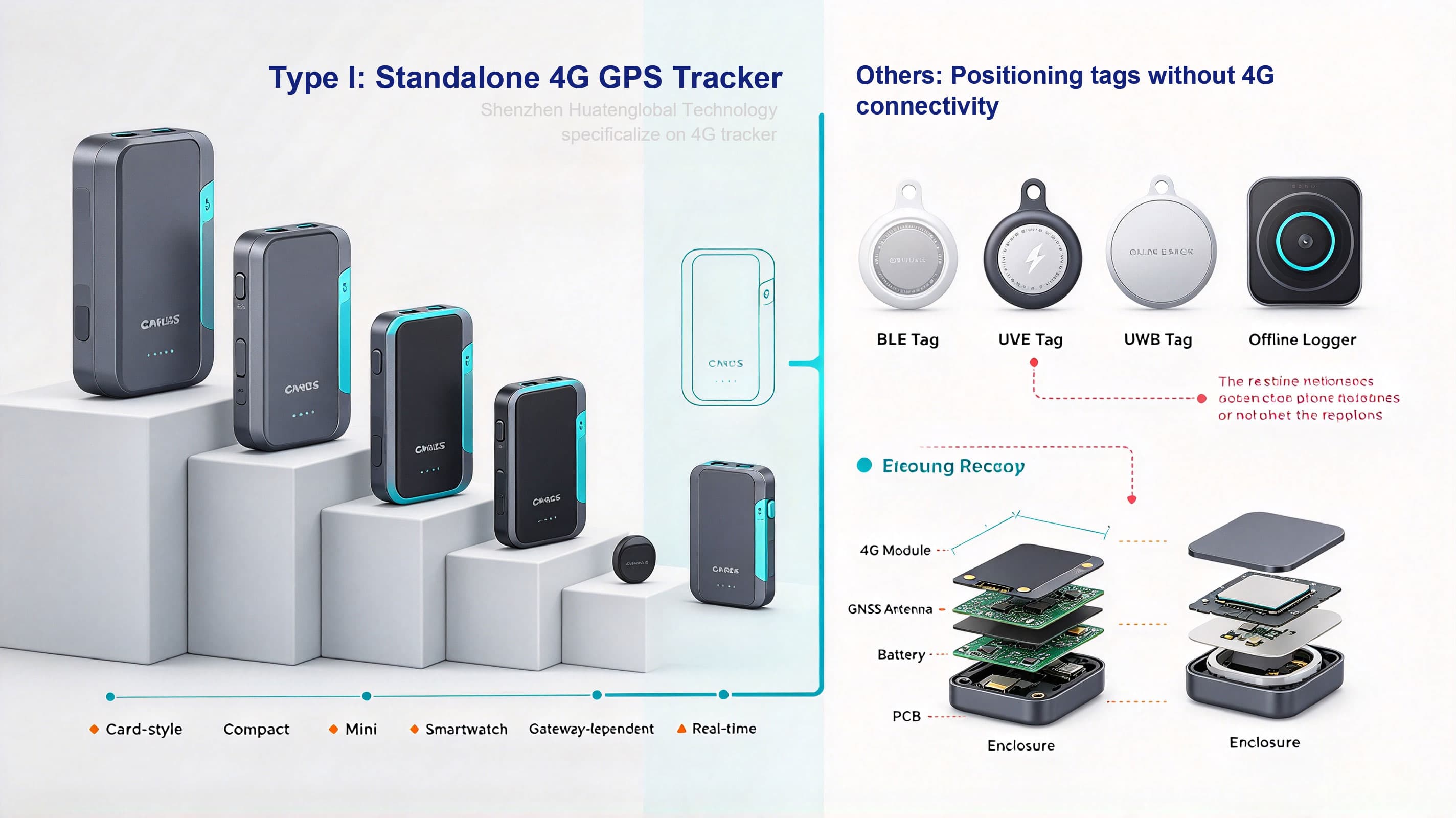
2.1 Commercial GPS Tracker dimensions
Having covered the physical and chemical levels constraints, here are the actual figures. The following dimensions are based on industry-level mass-production 4G small GPS tracking device capabilities for 2025–2026, rather than laboratory samples:
| Product Form | Ref. dimensions | Model | Battery Life | Positioning Method |
| Card/Badge-style | 85×54×5.5mm | I55 | 3–5 days | GNSS+LBS+WIFI |
| Compact Tracker | 55×30×10.0mm | A20S | 2–5 days | GNSS+LBS+WIFI |
| Smartwatch Tracker | 53×41×15.5mm | H15 | 2–3 days | GNSS+LBS+WIFI |
| Miniature Tracker | 38×25×8mm | - | 1–2 days | GNSS+LBS |
| Ultra-miniature (mass-producible) | 35×22×7.5mm | - | <1 day | GNSS+LBS |
For a fully functional 4G GPS tracker with a built-in battery and integrated cellular connectivity, the smallest commercially available models measure approximately 60 × 32 × 20 mm and weigh about 38 grams. Devices in this class — such as compact LTE Cat M1/NB2 personal or asset trackers — typically feature a 600–700mAh battery, providing 1 to 2 weeks of standby time in low-frequency reporting mode.
If the dimensions and weight lower than this threshold, what you are left with is no longer a standalone 4G tracker, but rather one of the following:
A GPS receiver module lacking cellular connectivity and a battery;
A Bluetooth tag or Airtag that relies on a nearby mobile phone for network access; or,
A research prototype that incorporates design compromises rendering it unsuitable for commercial deployment.
2.2 Positioning tags without 4G connectivity (BLE/UWB/offline loggers)
| Product Form | Reference dimensions | Battery life | Notes |
| BLE Location Tag | Φ25×4mm | 1 year+ | Relies on a mobile network for data reporting; not a standalone system. |
| AirTag | Φ31.9mm | 6 months+ | Communicates with Apple devices via BLE (Bluetooth Low Energy). |
| Offline Tracker Logger | 30×20×6mm | Several days | No real-time reporting; data is retrieved after the fact. |
Note: The reason AirTag can function as it does is that it lacks 4G cellular connectivity, relying solely on BLE (Bluetooth Low Energy) to communicate with Apple devices. This is not a matter of a technological gap, but rather a result of different physical constraints. Fitting a 4G module, a 4G antenna, a GNSS antenna, and a battery into the casing of an AirTag is something no one can currently achieve—nor is it likely to be feasible in the near future.
These are not "4G GPS trackers" in the true sense—they either rely on a mobile phone to act as a gateway or lack real-time communication capabilities. If your use case requires the device to operate independently and transmit location data in real time, you must accept the minimum physical footprint dictated by the inclusion of a 4G module, an antenna, and a battery. How to Select The Right Tracker for Your Business?
III. The "Minimal" Answer for Different Use Cases
For system integrators and solution providers, a more productive framing for inquiry is not "Which is the smallest tracker on the market?" but rather "Which is the smallest tracker that meets operational requirements without compromise?"
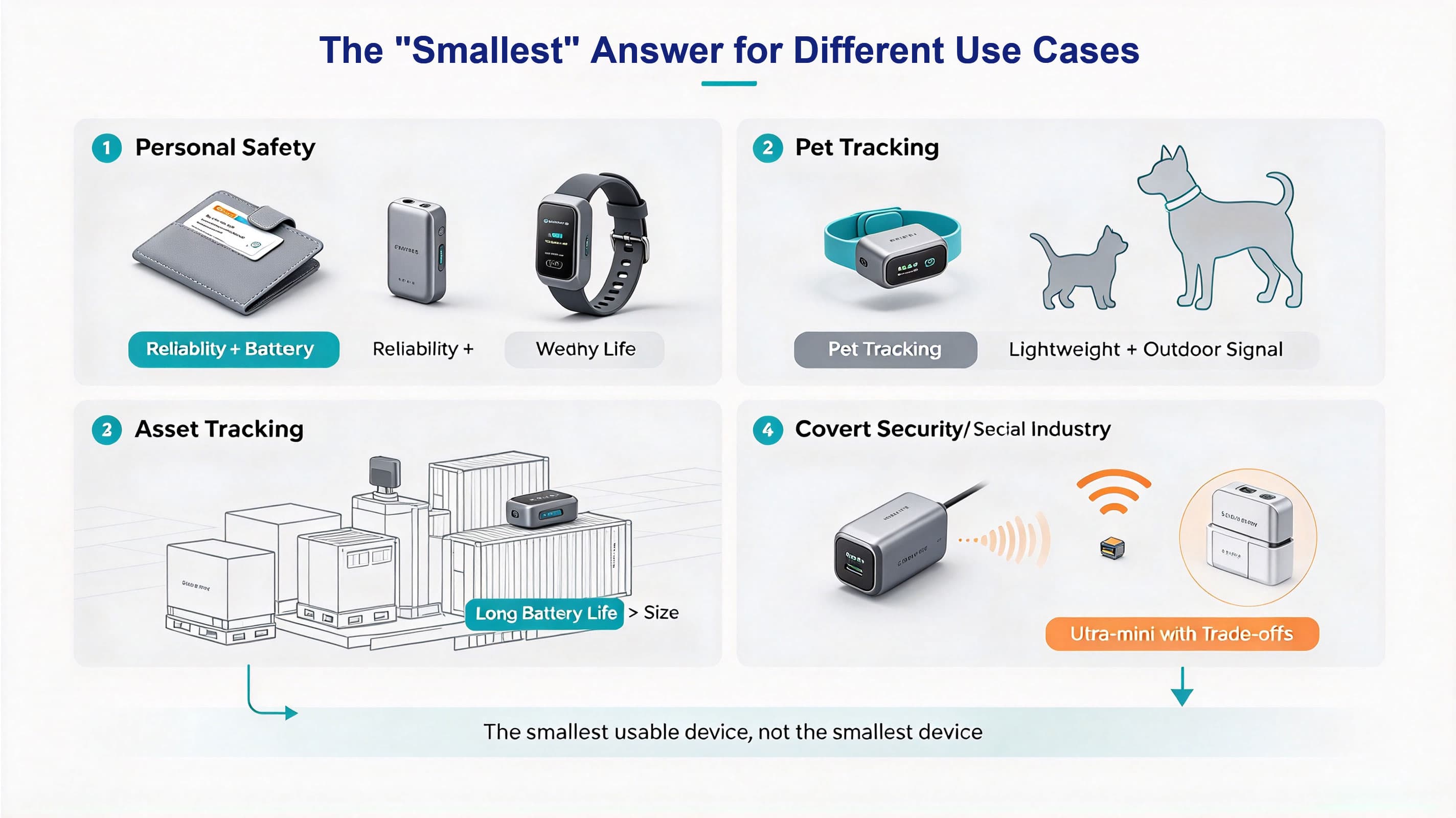
Scenario 1: Personal Safety (Children/Students/Seniors/Employees,etc.)
Typical Requirements: Wearable, Real-Time Location Tracking, SOS Alerts, 3–7 Days of Battery Life
Recommended Form Factors: Card-style, compact tracker, or wristband
Minimum Reference Dimensions: 85×54×5.5 mm (card-style) or 42×28×12 mm (compact) or 53×41×15.5 mm (wristband)
Why It Can't Be Any Smaller: Personal safety scenarios require reliability and long battery life. Users may only charge the device once a day, and it must remain connected at all times. Card-style devices utilize a large surface area to minimize thickness, aligning with usage habits for wallets and ID badges. Wristband-style devices are convenient to wear and less likely to be lost, making them a better choice. Forcing the device to be smaller would actually reduce usability.
Scenario 2: Pet Tracking
Typical Requirements: Collar-mounted, IP67+ water resistance, lightweight, 1–3 days of battery life.
Recommended Form Factor: Compact/micro tracker, integrated into a collar.
Minimum Reference Dimensions: 38×25×8 mm (for small dogs/cats) or 42×28×12 mm (for medium-sized dogs).
Key Trade-offs: Pet collars are highly sensitive to weight (generally, the device should not exceed 2–3% of the pet’s body weight). For cats and small dogs, the device weight must remain under 30~50 g, which directly limits battery capacity. Fortunately, since pets are primarily active outdoors, where GPS signal conditions are generally favorable, antenna specifications can be scaled down to achieve a more compact size.
Scenario 3: Asset Tracking (Equipment/Containers/Packages/Pallets)
Typical Requirements: Long battery life (several months), weather resistance, concealed installation, cost-sensitive
Recommended Form Factors: Medium-sized, long-battery-life models or magnetic-mount models
Minimum Reference Dimensions: Approximately 50×40×15 mm; however, the focus is not on “small size” but on “long battery life”
Why "Small" isn't the key: Asset tracking scenarios are much more tolerant of size. For a tracker attached to the undercarriage of an excavator, there’s little difference between 50 mm and 35 mm, but the difference between a 7-day and a 30-day battery life is enormous. In this scenario, we recommend that customers shift their focus from "smallest" to "longest battery life."
Scenario 4: Covert Security / Specialized Industries
Typical Requirements: Can be embedded inside clothing or equipment; difficult to detect; battery life can be compromised
Recommended Form Factor: Ultra-Miniature Custom Solution
Minimum Reference Dimensions: 35 × 22 × 7.5 mm (current mass-production limit)
Key Notes: This scenario truly pushes the limits of miniaturization, but requires a clear acceptance of compromises in battery life and positioning accuracy. Battery life may be as short as one day or even a few hours, and positioning in low-signal environments may be slower. As long as expectations are aligned in advance, these compromises are acceptable engineering trade-offs.
IV. Miniaturization Is Not the Only Answer: A Four-Dimensional Decision-Making Framework for Product Selection
4.1 smallest deployable size rather than smallest size
For integrators and solution providers, the truly meaningful question isn't "How small can a GPS locator be?" but rather "Given the requirements for battery life, reporting frequency, network lifecycle, and installation environment, what is the smallest deployable device?".
We've developed a framework based on four dimensions — size, battery life, positioning accuracy, and cost—where you can only optimize three of them at a time, and sometimes only two.
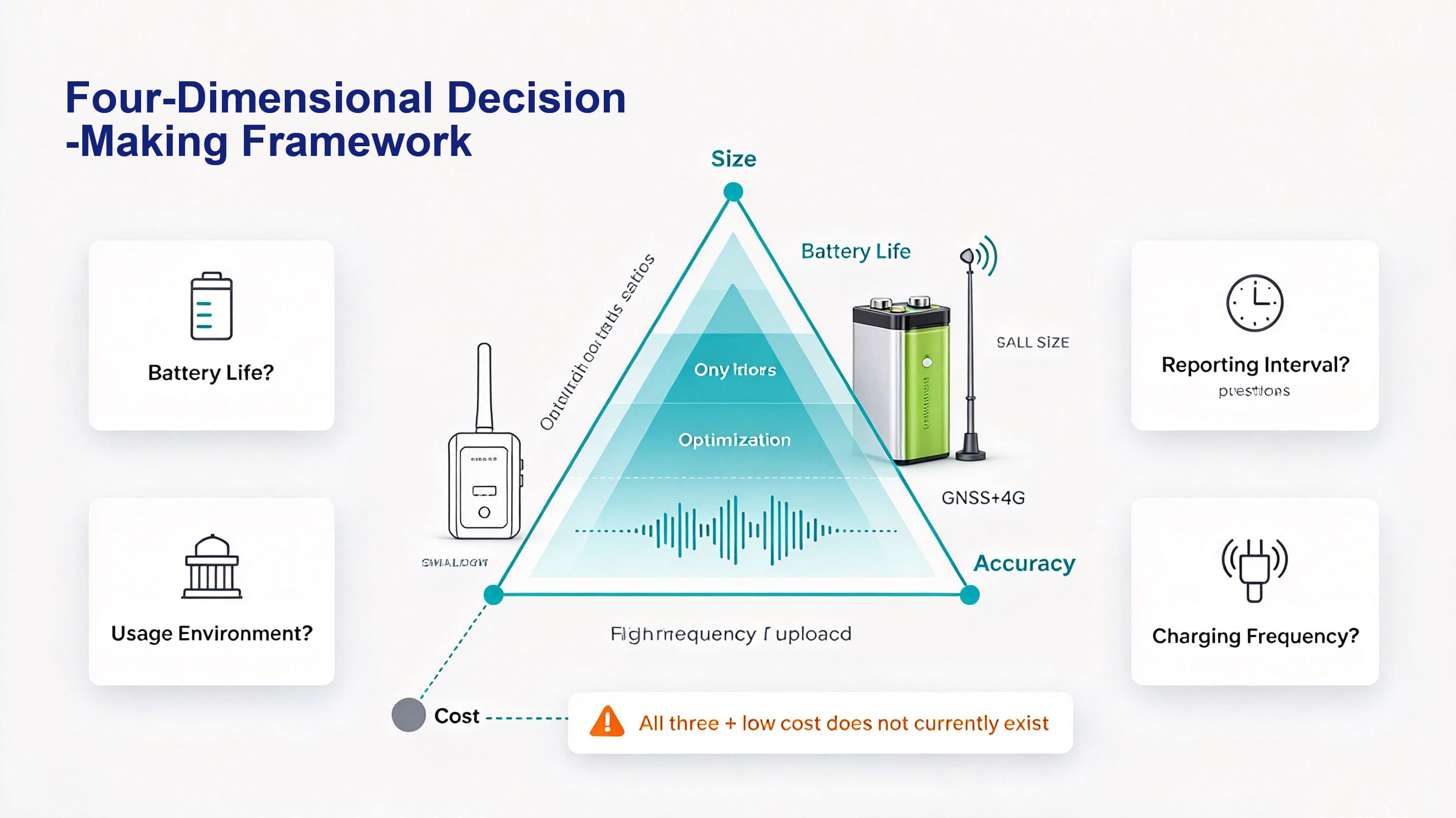
4.2 Engineering Realities
Small size + long battery life → Accuracy must be reduced (decrease positioning frequency, use Wi-Fi/cell towers instead of GNSS)
Small size + high accuracy → Battery life must be sacrificed (high-frequency GNSS + 4G data uploads drain power quickly)
Long battery life + high accuracy → The device will inevitably be large (large battery + full-size antenna)
All three + low cost → Does not currently exist.
4.3 Questions to Consider Before Making a Choice
Before launching a project, ask yourself these four questions:
Q1: What is the shortest battery life you can accept?
Determined the battery lower limit
Q2: What is the required reporting interval?
A tracker that reports its location every minute requires several times more battery power than one that reports hourly or is motion-activated. Before selecting hardware, define the minimum feasible update frequency.
Q3: What kind of environment is the device used in?
Indoor environments → GNSS becomes less important; WiFi and cell tower assistance become more important
Q4: How often are users willing to charge their devices?
The answer directly determines battery capacity → thickness
The answers to these four questions will naturally lead you to your product size range.
V. What We Can Do: Customization Capabilities and Limitations in Miniaturization
Back to the original question: "What are the smallest GPS trackers can be?"
Our answer is:
Standard Models (No Customization Required): The smallest 4G real-time GPS tracker we can provide measures approximately 55×30×10 mm;
Deep Customization (adjustments to antenna/battery/structure): Can be reduced to a minimum size of approximately 35×22×7.5 mm;
Extreme Customization (sacrificing battery life/accuracy/water resistance): We can work with the customer to evaluate even smaller designs, but acceptable performance trade-offs must be clearly defined before the project begins.
Our miniaturization capabilities stem from:
In-house stacked design that maximizes the use of every cubic millimeter of internal space
Close collaboration with multiple module manufacturers to prioritize the adoption of small-package Cat. 1 bis solutions
Mature eSIM surface-mount solutions that are already in mass production
Support for evaluating various miniaturized antenna solutions, including FPC and LDS antennas
We always tell our customers "no" when:
We do not promise sizes we cannot achieve (such as a "button-sized 4G real-time locator")
We do not ignore physical constraints (we clearly explain the performance trade-offs behind each size choice)
We do not make false promises just to win an order (miniaturization requires collaborative evaluation by both engineering teams—it is not a sales promise)
VI. Quick Answers to Common Questions
Q: Can it be as small as an AirTag?
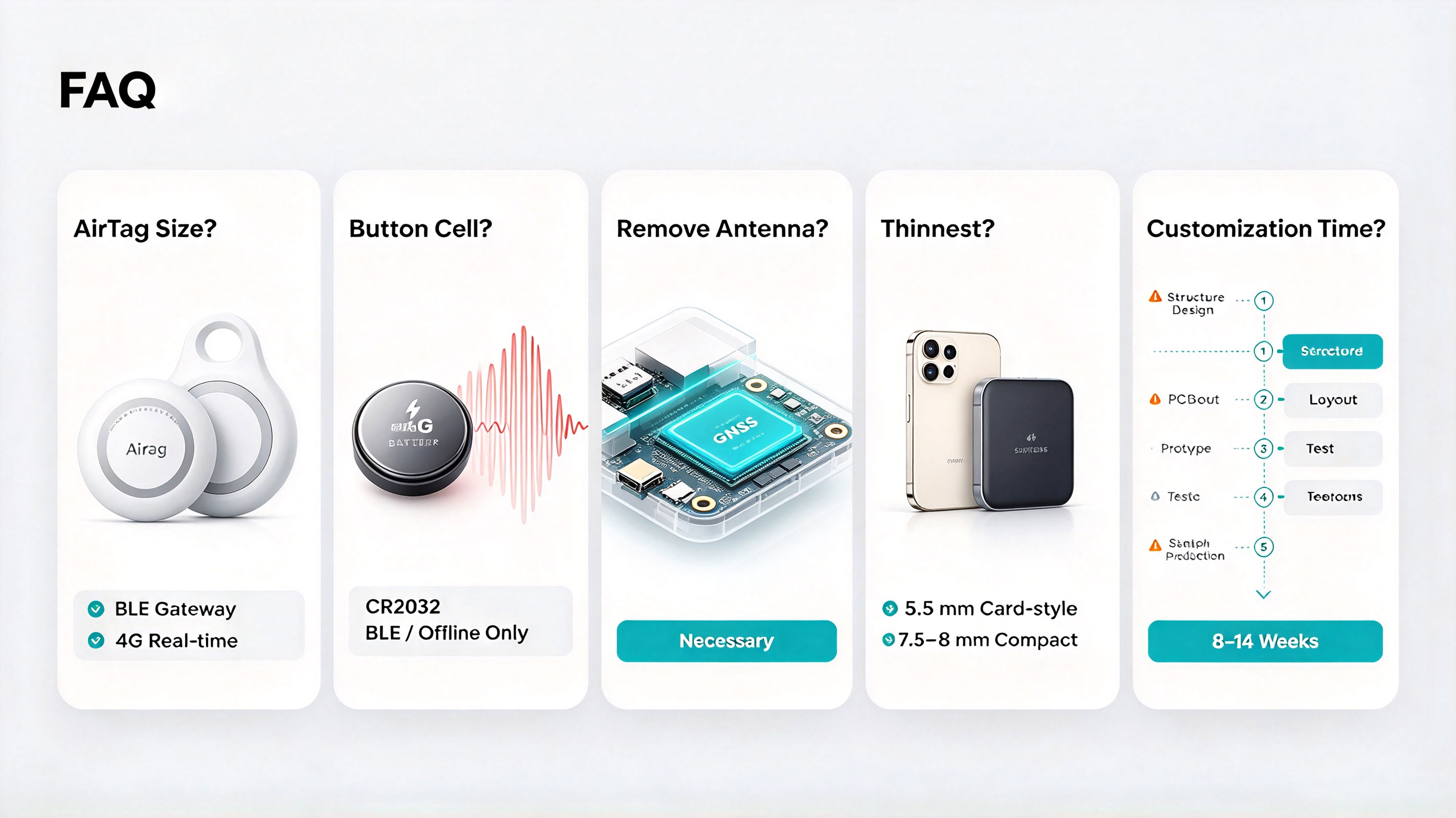
A: No. The AirTag does not have 4G cellular connectivity; it uses BLE and relies on the Apple device’s network. A 4G real-time GPS tracker requires an additional cellular antenna, a 4G module, and a larger battery; currently, the smallest models are about 1.5 to 2 times the size of an AirTag.
Q: Can a button cell battery power a GPS tracker?
A: It cannot power 4G real-time tracking. The peak discharge current of a button cell battery is insufficient to support the transmission power consumption of a 4G module. It can be used for BLE tags or offline loggers, but cannot support real-time cellular reporting.
Q: Can the antenna be removed?
A: No. GNSS and 4G antennas are physically necessary. Ceramic antennas can be replaced with PCB/FPC antennas to reduce thickness, but this will decrease signal reception capability. They cannot be removed entirely.
Q: What is the thinnest possible thickness?
A: The thinnest mass-producible 4G real-time GPS tracker currently available is approximately 5.5 mm (card-style), but it has a large XY footprint (about the size of a credit card). The thinnest compact model (with an area smaller than 50×30 mm) is approximately 7.5–8 mm.
Q: How long does it take to customize the smallest size?
A: It generally takes 8–14 weeks (structural design → PCB layout → prototyping → testing → small-batch production), depending on the degree of miniaturization and whether new molds are required.
Search
Previous
Next
IP Protection Ratings is Not Permanent: Is Your GPS Tracking Device Truly Waterproof and Dustproof?
Latest News
How small can a GPS tracker be? — The Limits of Miniaturization and the Technical Reality
IP Protection Ratings is Not Permanent: Is Your GPS Tracking Device Truly Waterproof and Dustproof?
Is that Smartwatch Health Monitoring Medical Grade? - Focus on Trends, Not Medical Grade Disease Diagnosis Criteria
Battery Life Decoding: Seven Key Factors Affecting Your GPS Tracker Battery Duration
Is GPS Positioning Truly Real-Time? — The Truth About "Real-Time" GPS Tracking